기본 콘텐츠로 건너뛰기

centerlate periodAtlantis (Ancient Greek: Ἀτλαντὶς νῆσος, Atlantis nesos, "island of Atlas") is a fictional island mentioned in an allegory on the hubris of nations in Plato's works Timaeus and Critias, wherein it represents the antagonist naval power that besieges "Ancient Athens", the pseudo-historic embodiment of Plato's ideal state in The Republic.[1] In the story, Athens repels the Atlantean attack unlike any other nation of the known world,[2] supposedly bearing witness to the superiority of Plato's concept of a state.[3][4] The story concludes with Atlantis falling out of favor with the deities and submerging into the Atlantic Ocean.


Atlantis

From Wikipedia, the free encyclopedia
Jump to navigationJump to search
Athanasius Kircher's map of Atlantis, placing it in the middle of the Atlantic Ocean, from Mundus Subterraneus 1669, published in Amsterdam. The map is oriented with south at the top.

Atlantis (Ancient Greek: Ἀτλαντὶς νῆσος, Atlantis nesos, "island of Atlas") is a fictional island mentioned in an allegory on the hubris of nations in Plato's works Timaeus and Critias, wherein it represents the antagonist naval power that besieges "Ancient Athens", the pseudo-historic embodiment of Plato's ideal state in The Republic.[1] In the story, Athens repels the Atlantean attack unlike any other nation of the known world,[2] supposedly bearing witness to the superiority of Plato's concept of a state.[3][4] The story concludes with Atlantis falling out of favor with the deities and submerging into the Atlantic Ocean.

Despite its minor importance in Plato's work, the Atlantis story has had a considerable impact on literature. The allegorical aspect of Atlantis was taken up in utopian works of several Renaissance writers, such as Francis Bacon's New Atlantis and Thomas More's Utopia.[5][6] On the other hand, nineteenth-century amateur scholars misinterpreted Plato's narrative as historical tradition, most famously Ignatius L. Donnelly in his Atlantis: The Antediluvian World. Plato's vague indications of the time of the events (more than 9,000 years before his time[7]) and the alleged location of Atlantis ("beyond the Pillars of Hercules") gave rise to much pseudoscientific speculation.[8] As a consequence, Atlantis has become a byword for any and all supposed advanced prehistoric lost civilizations and continues to inspire contemporary fiction, from comic books to films.

While present-day philologists and classicists agree on the story's fictional character,[9][10] there is still debate on what served as its inspiration. Plato is known to have freely borrowed some of his allegories and metaphors from older traditions, as he did, for instance, with the story of Gyges.[11] This led a number of scholars to investigate possible inspiration of Atlantis from Egyptian records of the Thera eruption,[12][13] the Sea Peoples invasion,[14] or the Trojan War.[15] Others have rejected this chain of tradition as implausible and insist that Plato created an entirely fictional account,[16][17][18] drawing loose inspiration from contemporary events such as the failed Athenian invasion of Sicily in 415–413 BC or the destruction of Helike in 373 BC.[19]

Plato's dialogues

Timaeus

A fifteenth-century Latin translation of Plato's Timaeus

The only primary sources for Atlantis are Plato's dialogues Timaeus and Critias; all other mentions of the island are based on them. The dialogues claim to quote Solon, who visited Egypt between 590 and 580 BC; they state that he translated Egyptian records of Atlantis.[20] Written in 360 BC, Plato introduced Atlantis in Timaeus:

For it is related in our records how once upon a time your State stayed the course of a mighty host, which, starting from a distant point in the Atlantic ocean, was insolently advancing to attack the whole of Europe, and Asia to boot. For the ocean there was at that time navigable; for in front of the mouth which you Greeks call, as you say, 'the pillars of Heracles,' there lay an island which was larger than Libya and Asia together; and it was possible for the travelers of that time to cross from it to the other islands, and from the islands to the whole of the continent over against them which encompasses that veritable ocean. For all that we have here, lying within the mouth of which we speak, is evidently a haven having a narrow entrance; but that yonder is a real ocean, and the land surrounding it may most rightly be called, in the fullest and truest sense, a continent. Now in this island of Atlantis there existed a confederation of kings, of great and marvelous power, which held sway over all the island, and over many other islands also and parts of the continent.[21]

The four people appearing in those two dialogues are the politicians Critias and Hermocrates as well as the philosophers Socrates and Timaeus of Locri, although only Critias speaks of Atlantis. In his works Plato makes extensive use of the Socratic method in order to discuss contrary positions within the context of a supposition.

The Timaeus begins with an introduction, followed by an account of the creations and structure of the universe and ancient civilizations. In the introduction, Socrates muses about the perfect society, described in Plato's Republic (c. 380 BC), and wonders if he and his guests might recollect a story which exemplifies such a society. Critias mentions a tale he considered to be historical, that would make the perfect example, and he then follows by describing Atlantis as is recorded in the Critias. In his account, ancient Athens seems to represent the "perfect society" and Atlantis its opponent, representing the very antithesis of the "perfect" traits described in the Republic.

Critias

According to Critias, the Hellenic deities of old divided the land so that each deity might have their own lot; Poseidon was appropriately, and to his liking, bequeathed the island of Atlantis. The island was larger than Ancient Libya and Asia Minor combined,[22][23] but it was later sunk by an earthquake and became an impassable mud shoal, inhibiting travel to any part of the ocean. Plato asserted that the Egyptians described Atlantis as an island consisting mostly of mountains in the northern portions and along the shore and encompassing a great plain in an oblong shape in the south "extending in one direction three thousand stadia [about 555 km; 345 mi], but across the center inland it was two thousand stadia [about 370 km; 230 mi]." Fifty stadia [9 km; 6 mi] from the coast was a mountain that was low on all sides ... broke it off all round about ... the central island itself was five stades in diameter [about 0.92 km; 0.57 mi].

In Plato's metaphorical tale, Poseidon fell in love with Cleito, the daughter of Evenor and Leucippe, who bore him five pairs of male twins. The eldest of these, Atlas, was made rightful king of the entire island and the ocean (called the Atlantic Ocean in his honor), and was given the mountain of his birth and the surrounding area as his fiefdom. Atlas's twin Gadeirus, or Eumelus in Greek, was given the extremity of the island toward the pillars of Hercules.[24] The other four pairs of twins—Ampheres and Evaemon, Mneseus and Autochthon, Elasippus and Mestor, and Azaes and Diaprepes—were also given "rule over many men, and a large territory."

Poseidon carved the mountain where his love dwelt into a palace and enclosed it with three circular moats of increasing width, varying from one to three stadia and separated by rings of land proportional in size. The Atlanteans then built bridges northward from the mountain, making a route to the rest of the island. They dug a great canal to the sea, and alongside the bridges carved tunnels into the rings of rock so that ships could pass into the city around the mountain; they carved docks from the rock walls of the moats. Every passage to the city was guarded by gates and towers, and a wall surrounded each ring of the city. The walls were constructed of red, white, and black rock, quarried from the moats, and were covered with brass, tin, and the precious metal orichalcum, respectively.

According to Critias, 9,000 years before his lifetime a war took place between those outside the Pillars of Hercules at the Strait of Gibraltar and those who dwelt within them. The Atlanteans had conquered the parts of Libya within the Pillars of Hercules, as far as Egypt, and the European continent as far as Tyrrhenia, and had subjected its people to slavery. The Athenians led an alliance of resistors against the Atlantean empire, and as the alliance disintegrated, prevailed alone against the empire, liberating the occupied lands.

But afterwards there occurred violent earthquakes and floods; and in a single day and night of misfortune all your warlike men in a body sank into the earth, and the island of Atlantis in like manner disappeared in the depths of the sea. For which reason the sea in those parts is impassable and impenetrable, because there is a shoal of mud in the way; and this was caused by the subsidence of the island.[25]

The logographer Hellanicus of Lesbos wrote an earlier work entitled Atlantis, of which only a few fragments survive. Hellanicus' work appears to have been a genealogical one concerning the daughters of Atlas (Ἀτλαντὶς in Greek means "of Atlas"),[12] but some authors have suggested a possible connection with Plato's island. John V. Luce notes that when Plato writes about the genealogy of Atlantis's kings, he writes in the same style as Hellanicus, suggesting a similarity between a fragment of Hellanicus's work and an account in the Critias.[12] Rodney Castleden suggests that Plato may have borrowed his title from Hellanicus, who may have based his work on an earlier work about Atlantis.[26]

Castleden has pointed out that Plato wrote of Atlantis in 359 BC, when he returned to Athens from Sicily. He notes a number of parallels between the physical organisation and fortifications of Syracuse and Plato's description of Atlantis.[27] Gunnar Rudberg was the first who elaborated upon the idea that Plato's attempt to realize his political ideas in the city of Syracuse could have heavily inspired the Atlantis account.[28]

Interpretations

Ancient

Reconstruction of the Oikoumene (inhabited world), an ancient map based on Herodotus' description of the world, circa 450 BC

Some ancient writers viewed Atlantis as fictional or metaphorical myth; others believed it to be real.[29] Aristotle believed that Plato, his teacher, had invented the island to teach philosophy.[20] The philosopher Crantor, a student of Plato's student Xenocrates, is cited often as an example of a writer who thought the story to be historical fact. His work, a commentary on Timaeus, is lost, but Proclus, a Neoplatonist of the fifth century AD, reports on it.[30] The passage in question has been represented in the modern literature either as claiming that Crantor visited Egypt, had conversations with priests, and saw hieroglyphs confirming the story, or, as claiming that he learned about them from other visitors to Egypt.[31] Proclus wrote:

As for the whole of this account of the Atlanteans, some say that it is unadorned history, such as Crantor, the first commentator on Plato. Crantor also says that Plato's contemporaries used to criticize him jokingly for not being the inventor of his Republic but copying the institutions of the Egyptians. Plato took these critics seriously enough to assign to the Egyptians this story about the Athenians and Atlanteans, so as to make them say that the Athenians really once lived according to that system.

The next sentence is often translated "Crantor adds, that this is testified by the prophets of the Egyptians, who assert that these particulars [which are narrated by Plato] are written on pillars which are still preserved." But in the original, the sentence starts not with the name Crantor but with the ambiguous He; whether this referred to Crantor or to Plato is the subject of considerable debate. Proponents of both Atlantis as a metaphorical myth and Atlantis as history have argued that the pronoun refers to Crantor.[32]

Alan Cameron argues that the pronoun should be interpreted as referring to Plato, and that, when Proclus writes that "we must bear in mind concerning this whole feat of the Athenians, that it is neither a mere myth nor unadorned history, although some take it as history and others as myth", he is treating "Crantor's view as mere personal opinion, nothing more; in fact he first quotes and then dismisses it as representing one of the two unacceptable extremes".[33]

Cameron also points out that whether he refers to Plato or to Crantor, the statement does not support conclusions such as Otto Muck's "Crantor came to Sais and saw there in the temple of Neith the column, completely covered with hieroglyphs, on which the history of Atlantis was recorded. Scholars translated it for him, and he testified that their account fully agreed with Plato's account of Atlantis"[34] or J. V. Luce's suggestion that Crantor sent "a special enquiry to Egypt" and that he may simply be referring to Plato's own claims.[33]

Another passage from the commentary by Proclus on the "Timaeus" gives a description of the geography of Atlantis:

That an island of such nature and size once existed is evident from what is said by certain authors who investigated the things around the outer sea. For according to them, there were seven islands in that sea in their time, sacred to Persephone, and also three others of enormous size, one of which was sacred to Hades, another to Ammon, and another one between them to Poseidon, the extent of which was a thousand stadia [200 km]; and the inhabitants of it—they add—preserved the remembrance from their ancestors of the immeasurably large island of Atlantis which had really existed there and which for many ages had reigned over all islands in the Atlantic sea and which itself had like-wise been sacred to Poseidon. Now these things Marcellus has written in his Aethiopica.[35]

Marcellus remains unidentified.

Other ancient historians and philosophers who believed in the existence of Atlantis were Strabo and Posidonius.[36] Some have theorized that, before the sixth century BC, the "Pillars of Hercules" may have applied to mountains on either side of the Gulf of Laconia, and also may have been part of the pillar cult of the Aegean.[37][38] The mountains stood at either side of the southernmost gulf in Greece, the largest in the Peloponnese, and it opens onto the Mediterranean Sea. This would have placed Atlantis in the Mediterranean, lending credence to many details in Plato's discussion.

The fourth-century historian Ammianus Marcellinus, relying on a lost work by Timagenes, a historian writing in the first century BC, writes that the Druids of Gaul said that part of the inhabitants of Gaul had migrated there from distant islands. Some have understood Ammianus's testimony as a claim that at the time of Atlantis's sinking into the sea, its inhabitants fled to western Europe; but Ammianus, in fact, says that "the Drasidae (Druids) recall that a part of the population is indigenous but others also migrated in from islands and lands beyond the Rhine" (Res Gestae 15.9), an indication that the immigrants came to Gaul from the north (Britain, the Netherlands, or Germany), not from a theorized location in the Atlantic Ocean to the south-west.[39] Instead, the Celts who dwelled along the ocean were reported to venerate twin gods, (Dioscori), who appeared to them coming from that ocean.[40]

Jewish and Christian

During the early first century, the Hellenistic Jewish philosopher Philo wrote about the destruction of Atlantis in his On the Eternity of the World, xxvi. 141, in a longer passage allegedly citing Aristotle's successor Theophrastus:[41]

... And the island of Atalantes [translator's spelling; original: "Ἀτλαντίς"] which was greater than Africa and Asia, as Plato says in the Timaeus, in one day and night was overwhelmed beneath the sea in consequence of an extraordinary earthquake and inundation and suddenly disappeared, becoming sea, not indeed navigable, but full of gulfs and eddies.[42]

The theologian Joseph Barber Lightfoot (Apostolic Fathers, 1885, II, p. 84) noted on this passage: "Clement may possibly be referring to some known, but hardly accessible land, lying without the pillars of Hercules. But more probably he contemplated some unknown land in the far west beyond the ocean, like the fabled Atlantis of Plato ..."[43]

Other early Christian writers wrote about Atlantis, although they had mixed views on whether it once existed or was an untrustworthy myth of pagan origin.[44] Tertullian believed Atlantis was once real and wrote that in the Atlantic Ocean once existed "[the isle] that was equal in size to Libya or Asia"[45] referring to Plato's geographical description of Atlantis. The early Christian apologist writer Arnobius also believed Atlantis once existed, but blamed its destruction on pagans.[46]

Cosmas Indicopleustes in the sixth century wrote of Atlantis in his Christian Topography in an attempt to prove his theory that the world was flat and surrounded by water:[47][page needed]

... In like manner the philosopher Timaeus also describes this Earth as surrounded by the Ocean, and the Ocean as surrounded by the more remote earth. For he supposes that there is to westward an island, Atlantis, lying out in the Ocean, in the direction of Gadeira (Cadiz), of an enormous magnitude, and relates that the ten kings having procured mercenaries from the nations in this island came from the earth far away, and conquered Europe and Asia, but were afterwards conquered by the Athenians, while that island itself was submerged by God under the sea. Both Plato and Aristotle praise this philosopher, and Proclus has written a commentary on him. He himself expresses views similar to our own with some modifications, transferring the scene of the events from the east to the west. Moreover he mentions those ten generations as well as that earth which lies beyond the Ocean. And in a word it is evident that all of them borrow from Moses, and publish his statements as their own.[48]

A map showing the supposed extent of the Atlantean Empire, from Ignatius L. Donnelly's Atlantis: the Antediluvian World, 1882[49]

Modern

Aside from Plato's original account, modern interpretations regarding Atlantis are an amalgamation of diverse, speculative movements that began in the sixteenth century,[50] when scholars began to identify Atlantis with the New World. Francisco Lopez de Gomara was the first to state that Plato was referring to America, as did Francis Bacon and Alexander von Humboldt; Janus Joannes Bircherod said in 1663 orbe novo non-novo ("the New World is not new"). Athanasius Kircher accepted Plato's account as literally true, describing Atlantis as a small continent in the Atlantic Ocean.[20]

Contemporary perceptions of Atlantis share roots with Mayanism, which can be traced to the beginning of the Modern Age, when European imaginations were fueled by their initial encounters with the indigenous peoples of the Americas.[51] From this era sprang apocalyptic and utopian visions that would inspire many subsequent generations of theorists.[51]

Most of these interpretations are considered pseudohistory, pseudoscience, or pseudoarchaeology, as they have presented their works as academic or scientific, but lack the standards or criteria.

The Flemish cartographer and geographer Abraham Ortelius is believed to have been the first person to imagine that the continents were joined before drifting to their present positions. In the 1596 edition of his Thesaurus Geographicus he wrote: "Unless it be a fable, the island of Gadir or Gades [Cadiz] will be the remaining part of the island of Atlantis or America, which was not sunk (as Plato reports in the Timaeus) so much as torn away from Europe and Africa by earthquakes and flood... The traces of the ruptures are shown by the projections of Europe and Africa and the indentations of America in the parts of the coasts of these three said lands that face each other to anyone who, using a map of the world, carefully considered them. So that anyone may say with Strabo in Book 2, that what Plato says of the island of Atlantis on the authority of Solon is not a figment."[52]

Atlantis pseudohistory

Early influential literature

The term "utopia" (from "no place") was coined by Sir Thomas More in his sixteenth-century work of fiction Utopia.[53] Inspired by Plato's Atlantis and travelers' accounts of the Americas, More described an imaginary land set in the New World.[54] His idealistic vision established a connection between the Americas and utopian societies, a theme that Bacon discussed in The New Atlantis (c. 1623).[51] A character in the narrative gives a history of Atlantis that is similar to Plato's and places Atlantis in America. People had begun believing that the Mayan and Aztec ruins could possibly be the remnants of Atlantis.[53]

Impact of Mayanism

Much speculation began as to the origins of the Maya, which led to a variety of narratives and publications that tried to rationalize the discoveries within the context of the Bible and that had undertones of racism in their connections between the Old and New World. The Europeans believed the indigenous people to be inferior and incapable of building that which was now in ruins and by sharing a common history, they insinuate that another race must have been responsible.

In the middle and late nineteenth century, several renowned Mesoamerican scholars, starting with Charles Etienne Brasseur de Bourbourg, and including Edward Herbert Thompson and Augustus Le Plongeon, formally proposed that Atlantis was somehow related to Mayan and Aztec culture.

The French scholar Brasseur de Bourbourg traveled extensively through Mesoamerica in the mid-1800s, and was renowned for his translations of Mayan texts, most notably the sacred book Popol Vuh, as well as a comprehensive history of the region. Soon after these publications, however, Brasseur de Bourbourg lost his academic credibility, due to his claim that the Maya peoples had descended from the Toltecs, people he believed were the surviving population of the racially superior civilization of Atlantis.[55] His work combined with the skillful, romantic illustrations of Jean Frederic Waldeck, which visually alluded to Egypt and other aspects of the Old World, created an authoritative fantasy that excited much interest in the connections between worlds.

Inspired by Brasseur de Bourbourg's diffusion theories, the pseudoarchaeologist Augustus Le Plongeon traveled to Mesoamerica and performed some of the first excavations of many famous Mayan ruins. Le Plongeon invented narratives, such as the kingdom of Mu saga, which romantically drew connections to him, his wife Alice, and Egyptian deities Osiris and Isis, as well as to Heinrich Schliemann, who had just discovered the ancient city of Troy from Homer's epic poetry (that had been described as merely mythical).[56][page range too broad] He also believed that he had found connections between the Greek and Mayan languages, which produced a narrative of the destruction of Atlantis.[57]

Ignatius Donnelly

The 1882 publication of Atlantis: the Antediluvian World by Ignatius L. Donnelly stimulated much popular interest in Atlantis. He was greatly inspired by early works in Mayanism, and like them, attempted to establish that all known ancient civilizations were descended from Atlantis, which he saw as a technologically sophisticated, more advanced culture. Donnelly drew parallels between creation stories in the Old and New Worlds, attributing the connections to Atlantis, where he believed the Biblical Garden of Eden existed.[58] As implied by the title of his book, he also believed that Atlantis was destroyed by the Great Flood mentioned in the Bible.

Donnelly is credited as the "father of the nineteenth century Atlantis revival" and is the reason the myth endures today.[59] He unintentionally promoted an alternative method of inquiry to history and science, and the idea that myths contain hidden information that opens them to "ingenious" interpretation by people who believe they have new or special insight.[60]

Madame Blavatsky and the Theosophists
Map of Atlantis according to William Scott-Elliott (The Story of Atlantis, Russian edition, 1910)

The Russian mystic Helena Petrovna Blavatsky and her partner Henry Steel Olcott founded their Theosophical Society in the 1870s with a philosophy that combined western romanticism and eastern religious concepts. Blavatsky and her followers in this group are often cited as the founders of New Age and other spiritual movements.[53]

Blavatsky took up Donnelly's interpretations when she wrote The Secret Doctrine (1888), which she claimed was originally dictated in Atlantis. She maintained that the Atlanteans were cultural heroes (contrary to Plato, who describes them mainly as a military threat). She believed in a form of racial evolution (as opposed to primate evolution). In her process of evolution the Atlanteans were the fourth "Root Race", which were succeeded by the fifth, the "Aryan race", which she identified with the modern human race.[53]

The Theosophists believed that the civilization of Atlantis reached its peak between 1,000,000 and 900,000 years ago, but destroyed itself through internal warfare brought about by the dangerous use of psychic and supernatural powers of the inhabitants. Rudolf Steiner, the founder of anthroposophy and Waldorf Schools, along with other well known Theosophists, such as Annie Besant, also wrote of cultural evolution in much the same vein. Some subsequent occultists have followed Blavatsky, at least to the point of tracing the lineage of occult practices back to Atlantis. Among the most famous is Dion Fortune in her Esoteric Orders and Their Work.[61]

Drawing on the ideas of Rudolf Steiner and Hanns Hörbiger, Egon Friedell started his book Kulturgeschichte des Altertums [de], and thus his historical analysis of antiquity, with the ancient culture of Atlantis. The book was published in 1940.

Nazism and occultism

Blavatsky was also inspired by the work of the 18th-century astronomer Jean-Sylvain Bailly, who had "Orientalized" the Atlantis myth in his mythical continent of Hyperborea, a reference to Greek myths featuring a Northern European region of the same name, home to a giant, godlike race.[62][63] Dan Edelstein claims that her reshaping of this theory in The Secret Doctrine provided the Nazis with a mythological precedent and a pretext for their ideological platform and their subsequent genocide.[62] However, Blavatsky's writings mention that the Atlantean were in fact olive-skinned peoples with Mongoloid traits who were the ancestors of modern Native Americans, Mongolians, and Malayans.[64][65][66]

The idea that the Atlanteans were Hyperborean, Nordic supermen who originated in the Northern Atlantic or even in the far North, was popular in the German ariosophic movement around 1900, propagated by Guido von List and others.[67] It gave its name to the Thule Gesellschaft, an antisemite Münich lodge, which preceded the German Nazi Party (see Thule). The scholars Karl Georg Zschaetzsch [de] (1920) and Herman Wirth (1928) were the first to speak of a "Nordic-Atlantean" or "Aryan-Nordic" master race that spread from Atlantis over the Northern Hemisphere and beyond. The Hyperboreans were contrasted with the Jewish people. Party ideologist Alfred Rosenberg (in The Myth of the Twentieth Century, 1930) and SS-leader Heinrich Himmler made it part of the official doctrine.[68] The idea was followed up by the adherents of Esoteric Nazism such as Julius Evola (1934) and, more recently, Miguel Serrano (1978).

The idea of Atlantis as the homeland of the Caucasian race would contradict the beliefs of older Esoteric and Theosophic groups, which taught that the Atlanteans were non-Caucasian brown-skinned peoples. Modern Esoteric groups, including the Theosophic Society, do not consider Atlantean society to have been superior or Utopian—they rather consider it a lower stage of evolution.[69]

Edgar Cayce

The clairvoyant Edgar Cayce spoke frequently of Atlantis. During his "life readings", he claimed that many of his subjects were reincarnations of people who had lived there. By tapping into their collective consciousness, the "Akashic Records" (a term borrowed from Theosophy),[70] Cayce declared that he was able to give detailed descriptions of the lost continent.[71] He also asserted that Atlantis would "rise" again in the 1960s (sparking much popularity of the myth in that decade) and that there is a "Hall of Records" beneath the Egyptian Sphinx which holds the historical texts of Atlantis.

Recent times

As continental drift became widely accepted during the 1960s, and the increased understanding of plate tectonics demonstrated the impossibility of a lost continent in the geologically recent past,[72] most "Lost Continent" theories of Atlantis began to wane in popularity.

Plato scholar Julia Annas, Regents Professor of Philosophy at the University of Arizona, had this to say on the matter:

The continuing industry of discovering Atlantis illustrates the dangers of reading Plato. For he is clearly using what has become a standard device of fiction—stressing the historicity of an event (and the discovery of hitherto unknown authorities) as an indication that what follows is fiction. The idea is that we should use the story to examine our ideas of government and power. We have missed the point if instead of thinking about these issues we go off exploring the sea bed. The continuing misunderstanding of Plato as historian here enables us to see why his distrust of imaginative writing is sometimes justified.[73]

One of the proposed explanations for the historical context of the Atlantis story is a warning of Plato to his contemporary fourth-century fellow-citizens against their striving for naval power.[18]

Kenneth Feder points out that Critias's story in the Timaeus provides a major clue. In the dialogue, Critias says, referring to Socrates' hypothetical society:

And when you were speaking yesterday about your city and citizens, the tale which I have just been repeating to you came into my mind, and I remarked with astonishment how, by some mysterious coincidence, you agreed in almost every particular with the narrative of Solon. ...[74]

Feder quotes A. E. Taylor, who wrote, "We could not be told much more plainly that the whole narrative of Solon's conversation with the priests and his intention of writing the poem about Atlantis are an invention of Plato's fancy."[75]

Location hypotheses

Since Donnelly's day, there have been dozens of locations proposed for Atlantis, to the point where the name has become a generic concept, divorced from the specifics of Plato's account. This is reflected in the fact that many proposed sites are not within the Atlantic at all. Few today are scholarly or archaeological hypotheses, while others have been made by psychic (e.g., Edgar Cayce) or other pseudoscientific means. (The Atlantis researchers Jacques Collina-Girard and Georgeos Díaz-Montexano, for instance, each claim the other's hypothesis is pseudoscience.)[76] Many of the proposed sites share some of the characteristics of the Atlantis story (water, catastrophic end, relevant time period), but none has been demonstrated to be a true historical Atlantis.

Satellite image of the islands of Santorini. From the Minoan eruption event, and the 1964 discovery of Akrotiri on the island, this location is one of many sites purported to have been the location of Atlantis.

In or near the Mediterranean Sea

Most of the historically proposed locations are in or near the Mediterranean Sea: islands such as Sardinia,[77][78][79] Crete, Santorini (Thera), Sicily, Cyprus, and Malta; land-based cities or states such as Troy,[80][page needed] Tartessos, and Tantalis (in the province of Manisa, Turkey);[81] Israel-Sinai or Canaan;[citation needed] and northwestern Africa.[82]

The Thera eruption, dated to the seventeenth or sixteenth century BC, caused a large tsunami that some experts hypothesize devastated the Minoan civilization on the nearby island of Crete, further leading some to believe that this may have been the catastrophe that inspired the story.[83][84] In the area of the Black Sea the following locations have been proposed: Bosporus and Ancomah (a legendary place near Trabzon).

Others have noted that, before the sixth century BC, the mountains on either side of the Gulf of Laconia were called the "Pillars of Hercules",[37][38] and they could be the geographical location being described in ancient reports upon which Plato was basing his story. The mountains stood at either side of the southernmost gulf in Greece, the largest in the Peloponnese, and that gulf opens onto the Mediterranean Sea. If from the beginning of discussions, misinterpretation of Gibraltar as the location rather than being at the Gulf of Laconia, would lend itself to many erroneous concepts regarding the location of Atlantis. Plato may have not been aware of the difference. The Laconian pillars open to the south toward Crete and beyond which is Egypt. The Thera eruption and the Late Bronze Age collapse affected that area and might have been the devastation to which the sources used by Plato referred. Significant events such as these would have been likely material for tales passed from one generation to another for almost a thousand years.

In the Atlantic Ocean

The location of Atlantis in the Atlantic Ocean has a certain appeal given the closely related names. Popular culture often places Atlantis there, perpetuating the original Platonic setting as they understand it. The Canary Islands and Madeira Islands have been identified as a possible location,[85][86][87][88] west of the Straits of Gibraltar, but in relative proximity to the Mediterranean Sea. Detailed studies of their geomorphology and geology have demonstrated, however, that they have been steadily uplifted, without any significant periods of subsidence, over the last four million years, by geologic processes such as erosional unloading, gravitational unloading, lithospheric flexure induced by adjacent islands, and volcanic underplating.[89][90]

Various islands or island groups in the Atlantic were also identified as possible locations, notably the Azores.[87][88] Similarly, cores of sediment covering the ocean bottom surrounding the Azores and other evidence demonstrate that it has been an undersea plateau for millions of years.[91][92] The area is known for its volcanism however, which is associated with rifting along the Azores Triple Junction. The spread of the crust along the existing faults and fractures has produced many volcanic and seismic events.[93] The area is supported by a buoyant upwelling in the deeper mantle, which some associate with an Azores hotspot.[94] Most of the volcanic activity has occurred primarily along the Terceira Rift. From the beginning of the islands' settlement, around the 15th century, there have been about 30 volcanic eruptions (terrestrial and submarine) as well as numerous, powerful earthquakes.[95] The island of São Miguel in the Azores is the site of the Sete Cidades volcano and caldera, which are the byproducts of historical volcanic activity in the Azores.[96]

The submerged island of Spartel near the Strait of Gibraltar has also been suggested.[97]

Ireland

In 2004, Swedish physiographist Ulf Erlingsson[98] proposed that the legend of Atlantis was based on Stone Age Ireland. He later stated that he does not believe that Atlantis ever existed but maintained that his hypothesis that its description matches Ireland's geography has a 99.8% probability. The director of the National Museum of Ireland commented that there was no archaeology supporting this.[99]

In Europe

Map showing hypothetical extent of Doggerland (c. 8,000 BC), which provided a land bridge between Great Britain and continental Europe

Several hypotheses place the sunken island in northern Europe, including Doggerland in the North Sea, and Sweden (by Olof Rudbeck in Atland, 1672–1702). Doggerland, as well as Viking Bergen Island, is thought to have been flooded by a megatsunami following the Storegga slide of c. 6100 BC. Some have proposed the Celtic Shelf as a possible location, and that there is a link to Ireland.[100]

In 2011, a team, working on a documentary for the National Geographic Channel,[101] led by Professor Richard Freund from the University of Hartford, claimed to have found possible evidence of Atlantis in southwestern Andalusia.[102] The team identified its possible location within the marshlands of the Doñana National Park, in the area that once was the Lacus Ligustinus,[103] between the Huelva, Cádiz, and Seville provinces, and they speculated that Atlantis had been destroyed by a tsunami,[104] extrapolating results from a previous study by Spanish researchers, published four years earlier.[105]

Spanish scientists have dismissed Freund's speculations, claiming that he sensationalised their work. The anthropologist Juan Villarías-Robles, who works with the Spanish National Research Council, said, "Richard Freund was a newcomer to our project and appeared to be involved in his own very controversial issue concerning King Solomon's search for ivory and gold in Tartessos, the well documented settlement in the Doñana area established in the first millennium BC", and described Freund's claims as "fanciful".[106]

A similar theory had previously been put forward by a German researcher, Rainer W. Kühne, that is based only on satellite imagery and places Atlantis in the Marismas de Hinojos, north of the city of Cádiz.[97] Before that, the historian Adolf Schulten had stated in the 1920s that Plato had used Tartessos as the basis for his Atlantis myth.[107]

Other locations

Several writers, such as Flavio Barbiero as early as 1974,[108] have speculated that Antarctica is the site of Atlantis.[109][110][page needed] A number of claims involve the Caribbean, such as an alleged underwater formation off the Guanahacabibes peninsula in Cuba.[111] The adjacent Bahamas or the folkloric Bermuda Triangle have been proposed as well. Areas in the Pacific and Indian Oceans have also been proposed, including Indonesia (i.e. Sundaland).[112][page needed] The stories of a lost continent off the coast of India, named "Kumari Kandam", have inspired some to draw parallels to Atlantis.[113][page needed]

Literary interpretations

Ancient versions

A fragment of Atlantis by Hellanicus of Lesbos

In order to give his account of Atlantis verisimilitude, Plato mentions that the story was heard by Solon in Egypt, and transmitted orally over several generations through the family of Dropides, until it reached Critias, a dialogue speaker in Timaeus and Critias.[114] Solon had supposedly tried to adapt the Atlantis oral tradition into a poem (that if published, was to be greater than the works of Hesiod and Homer). While it was never completed, Solon passed on the story to Dropides. Modern classicists deny the existence of Solon's Atlantis poem and the story as an oral tradition.[115] Instead, Plato is thought to be the sole inventor or fabricator. Hellanicus of Lesbos used the word "Atlantis" as the title for a poem published before Plato,[116] a fragment of which may be Oxyrhynchus Papyrus 11, 1359.[117] This work only describes the Atlantides (the daughters of Atlas), however, and has no relation to Plato's Atlantis account.

In the new era, the third century AD Neoplatonist Zoticus wrote an epic poem based on Plato's account of Atlantis.[118] Plato's work may already have inspired parodic imitation, however. Writing only a few decades after the Timaeus and Critias, the historian Theopompus of Chios wrote of a land beyond the ocean known as Meropis. This description was included in Book 8 of his Philippica, which contains a dialogue between Silenus and King Midas. Silenus describes the Meropids, a race of men who grow to twice normal size, and inhabit two cities on the island of Meropis: Eusebes (Εὐσεβής, "Pious-town") and Machimos (Μάχιμος, "Fighting-town"). He also reports that an army of ten million soldiers crossed the ocean to conquer Hyperborea, but abandoned this proposal when they realized that the Hyperboreans were the luckiest people on earth. Heinz-Günther Nesselrath has argued that these and other details of Silenus' story are meant as imitation and exaggeration of the Atlantis story, by parody, for the purpose of exposing Plato's ideas to ridicule.[119]

Utopias and dystopias

The creation of Utopian and dystopian fictions was renewed after the Renaissance, most notably in Francis Bacon's New Atlantis (1627), the description of an ideal society that he located off the western coast of America. Thomas Heyrick (1649-1694) followed him with "The New Atlantis" (1687), a satirical poem in three parts. His new continent of uncertain location, perhaps even a floating island either in the sea or the sky, serves as background for his exposure of what he described in a second edition as "A True Character of Popery and Jesuitism".[120]

The title of The New Atalantis by Delarivier Manley (1709), distinguished from the two others by the single letter, is an equally dystopian work but set this time on a fictional Mediterranean island.[121] In it sexual violence and exploitation is made a metaphor for the hypocritical behaviour of politicians in their dealings with the general public.[122] In Manley's case, the target of satire was the Whig Party, while in David Maclean Parry's The Scarlet Empire (1906) it is Socialism as practised in foundered Atlantis.[123] It was followed in Russia by Velemir Khlebnikov's poem The Fall of Atlantis (Gibel' Atlantidy, 1912), which is set in a future rationalist dystopia that has discovered the secret of immortality and is so dedicated to progress that it has lost touch with the past. When the high priest of this ideology is tempted by a slave girl into an act of irrationality, he murders her and precipitates a second flood, above which her severed head floats vengefully among the stars.[124]

A slightly later work, The Ancient of Atlantis (Boston, 1915) by Albert Armstrong Manship, expounds the Atlantean wisdom that is to redeem the earth. Its three parts consist of a verse narrative of the life and training of an Atlantean wise one, followed by his Utopian moral teachings and then a psychic drama set in modern times in which a reincarnated child embodying the lost wisdom is reborn on earth.[125]

In Hispanic eyes, Atlantis had a more intimate interpretation. The land had been a colonial power which, although it had brought civilization to ancient Europe, had also enslaved its peoples. Its tyrannical fall from grace had contributed to the fate that had overtaken it, but now its disappearance had unbalanced the world. This was the point of view of Jacint Verdaguer's vast mythological epic L'Atlantida (1877). After the sinking of the former continent, Hercules travels east across the Atlantic to found the city of Barcelona and then departs westward again to the Hesperides. The story is told by a hermit to a shipwrecked mariner, who is inspired to follow in his tracks and so "call the New World into existence to redress the balance of the Old". This mariner, of course, was Christopher Columbus.[126]

Verdaguer's poem was written in Catalan, but was widely translated in both Europe and Hispano-America.[127] One response was the similarly entitled Argentinian Atlantida of Olegario Victor Andrade (1881), which sees in "Enchanted Atlantis that Plato foresaw, a golden promise to the fruitful race" of Latins.[128] The bad example of the colonising world remains, however. Jose Juan Tablada characterises its threat in his "De Atlántida" (1894) through the beguiling picture of the lost world populated by the underwater creatures of Classical myth, among whom is the Siren of its final stanza with

her eye on the keel of the wandering vessel
that in passing deflowers the sea's smooth mirror,
launching into the night her amorous warbling
and the dulcet lullaby of her treacherous voice![129]

There is a similar ambivalence in Janus Djurhuus' six-stanza "Atlantis" (1917), where a celebration of the Faroese linguistic revival grants it an ancient pedigree by linking Greek to Norse legend. In the poem a female figure rising from the sea against a background of Classical palaces is recognised as a priestess of Atlantis. The poet recalls "that the Faroes lie there in the north Atlantic Ocean/ where before lay the poet-dreamt lands," but also that in Norse belief, such a figure only appears to those about to drown.[130]

A land lost in the distance

A Faroe Islands postage stamp honoring Janus Djurhuus' "Atlantis"

The fact that Atlantis is a lost land has made of it a metaphor for something no longer attainable. For the American poet Edith Willis Linn Forbes (1865-1945), "The Lost Atlantis" stands for idealisation of the past; the present moment can only be treasured once that is realised.[131] Ella Wheeler Wilcox finds the location of "The Lost Land" (1910) in one's carefree youthful past.[132] Similarly, for the Irish poet Eavan Boland in "Atlantis, a lost sonnet" (2007), the idea was defined when "the old fable-makers searched hard for a word/ to convey that what is gone is gone forever".[133]

For some male poets too, the idea of Atlantis is constructed from what cannot be obtained. Charles Bewley in his Newdigate Prize poem (1910) thinks it grows from dissatisfaction with one's condition,

And, because life is partly sweet
And ever girt about with pain,
We take the sweetness, and are fain
To set it free from grief's alloy

in a dream of Atlantis.[134] Similarly for the Australian Gary Catalano in a 1982 prose poem, it is "a vision that sank under the weight of its own perfection".[135] W. H. Auden, however, suggests a way out of such frustration through the metaphor of journeying toward Atlantis in his poem of 1941.[136] While travelling, he advises the one setting out, you will meet with many definitions of the goal in view, only realising at the end that the way has all the time led inward.[137]

Epic narratives

A few late-19th century verse narratives complement the genre fiction that was beginning to be written at the same period. Two of them report the disaster that overtook the continent as related by long-lived survivors. In Frederick Tennyson's Atlantis (1888), an ancient Greek mariner sails west and discovers an inhabited island which is all that remains of the former kingdom. He learns of its end and views the shattered remnant of its former glory, from which a few had escaped to set up the Mediterranean civilisations.[138] In the second, Mona, Queen of Lost Atlantis: An Idyllic Re-embodiment of Long Forgotten History (Los Angeles CA 1925) by James Logue Dryden (1840–1925), the story is told in a series of visions. A Seer is taken to Mona's burial chamber in the ruins of Atlantis, where she revives and describes the catastrophe. There follows a survey of the lost civilisations of Hyperborea and Lemuria as well as Atlantis, accompanied by much spiritualist lore.[139]

William Walton Hoskins (1856–1919) admits to the readers of his Atlantis and other poems (Cleveland OH, 1881), that he is only 24. Its melodramatic plot concerns the poisoning of the descendant of god-born kings. The usurping poisoner is poisoned in his turn, following which the continent is swallowed in the waves.[140] Asian gods people the landscape of The Lost Island (Ottawa 1889) by Edward Taylor Fletcher (1816–97). An angel foresees impending catastrophe and that the people will be allowed to escape if their semi-divine rulers will sacrifice themselves.[141] A final example, Edward N. Beecher's The Lost Atlantis or The Great Deluge of All (Cleveland OH, 1898) is just a doggerel vehicle for its author's opinions: that the continent was the location of the Garden of Eden; that Darwin's theory of evolution is correct, as are Donnelly's views.[142]

Atlantis was to become a theme in Russia following the 1890s, taken up in unfinished poems by Valery Bryusov and Konstantin Balmont, as well as in a drama by the schoolgirl Larisa Reisner.[143] One other long narrative poem was published in New York by George V. Golokhvastoff. His 250-page The Fall of Atlantis (1938) records how a high priest, distressed by the prevailing degeneracy of the ruling classes, seeks to create an androgynous being from royal twins as a means to overcome this polarity. When he is unable to control the forces unleashed by his occult ceremony, the continent is destroyed.[144]

Artistic representations

Music

The Spanish composer Manuel de Falla worked on a dramatic cantata based on Verdaguer's L'Atlántida, during the last 20 years of his life.[145] The name has been affixed to symphonies by Janis Ivanovs (1941),[146] Richard Nanes,[147] and Vaclav Buzek (2009).[148] There was also the symphonic celebration of Alan Hovhaness: "Fanfare for the New Atlantis" (Op. 281, 1975).[149]

The Bohemian-American composer and arranger Vincent Frank Safranek wrote Atlantis (The Lost Continent) Suite in Four Parts; I. Nocturne and Morning Hymn of Praise, II. A Court Function, III. "I Love Thee" (The Prince and Aana), IV. The Destruction of Atlantis, for military (concert) band in 1913.[150]

The opera Der Kaiser von Atlantis (The Emperor of Atlantis) was written in 1943 by Viktor Ullmann with a libretto by Peter Kien, while they were both inmates at the Nazi concentration camp of Theresienstadt. The Nazis did not allow it to be performed, assuming the opera's reference to an Emperor of Atlantis to be a satire on Hitler. Though Ullmann and Kiel were murdered in Auschwitz, the manuscript survived and was performed for the first time in 1975 in Amsterdam.[151][152][153]

Painting and sculpture

François de Nomé's The Fall of Atlantis
Nicholas Roerich's The Last of Atlantis
Léon Bakst's vision of cosmic catastrophe

Paintings of the submersion of Atlantis are comparatively rare. In the seventeenth century there was François de Nomé's The Fall of Atlantis, which shows a tidal wave surging toward a Baroque city frontage. The style of architecture apart, it is not very different from Nicholas Roerich's The Last of Atlantis of 1928.

The most dramatic depiction of the catastrophe was Léon Bakst's Ancient Terror (Terror Antiquus, 1908), although it does not name Atlantis directly. It is a mountain-top view of a rocky bay breached by the sea, which is washing inland about the tall structures of an ancient city. A streak of lightning crosses the upper half of the painting, while below it rises the impassive figure of an enigmatic goddess who holds a blue dove between her breasts. Vyacheslav Ivanov identified the subject as Atlantis in a public lecture on the painting given in 1909, the year it was first exhibited, and he has been followed by other commentators in the years since.[154]

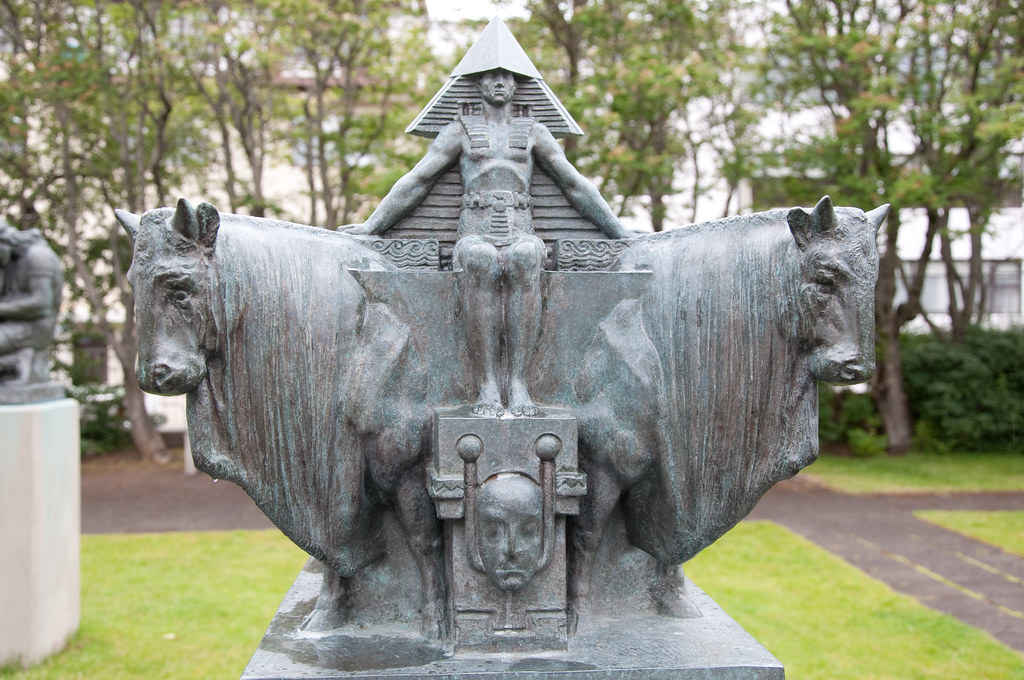
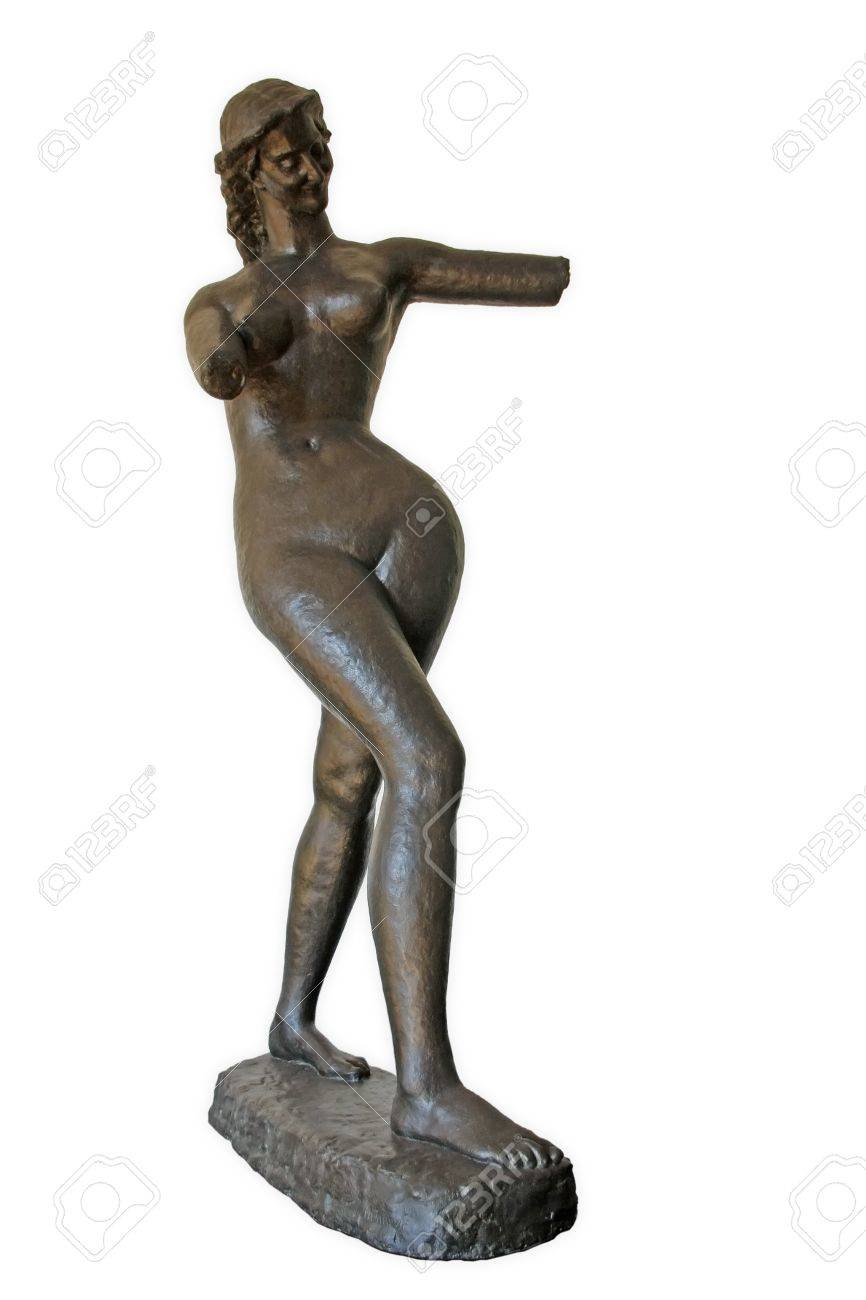
Sculptures referencing Atlantis have often been stylized single figures. One of the earliest was Einar Jónsson's The King of Atlantis (1919–1922), now in the garden of his museum in Reykjavík. It represents a single figure, clad in a belted skirt and wearing a large triangular helmet, who sits on an ornate throne supported between two young bulls.[155] The walking female entitled Atlantis (1946) by Ivan Meštrović[156] was from a series inspired by ancient Greek figures[157] with the symbolical meaning of unjustified suffering.[158]

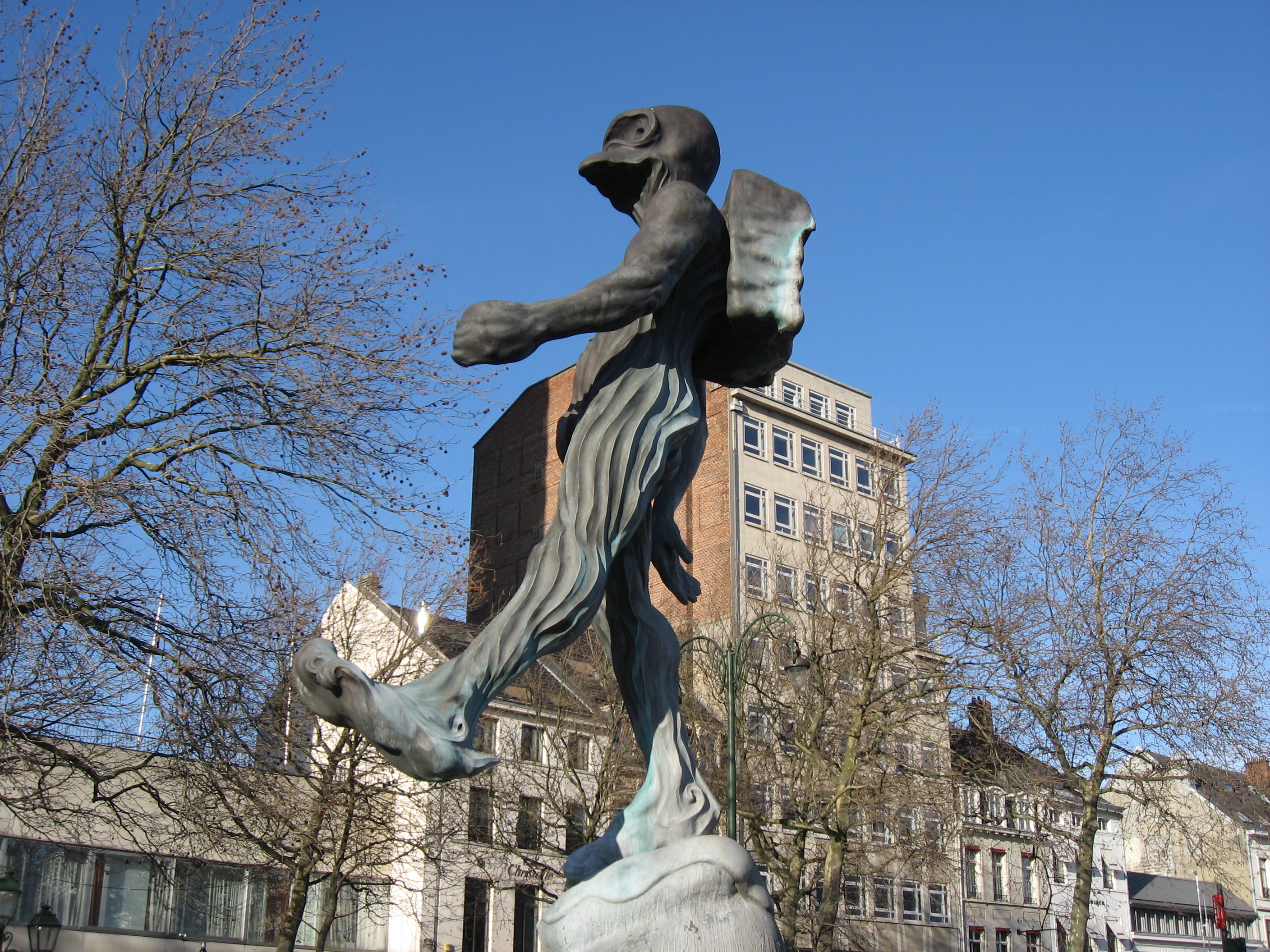
In the case of the Brussels fountain feature known as The Man of Atlantis (2003) by the Belgian sculptor Luk van Soom [nl], the 4-metre tall figure wearing a diving suit steps from a plinth into the spray.[159] It looks light-hearted but the artist's comment on it makes a serious point: "Because habitable land will be scarce, it is no longer improbable that we will return to the water in the long term. As a result, a portion of the population will mutate into fish-like creatures. Global warming and rising water levels are practical problems for the world in general and here in the Netherlands in particular".[160]

Robert Smithson's Hypothetical Continent (Map of broken clear glass, Atlantis) was first created as a photographical project on Loveladies Island NJ in 1969,[161] and then recreated as a gallery installation of broken glass.[162] On this he commented that he liked "landscapes that suggest prehistory", and this is borne out by the original conceptual drawing of the work that includes an inset map of the continent sited off the coast of Africa and at the straits into the Mediterranean.[163]

See also

Underwater geography:

General:

Notes

  1. ^ Hale, John R. (2009). Lords of the Sea: The Epic Story of the Athenian Navy and the Birth of Democracy. New York: Penguin. p. 368. ISBN 978-0-670-02080-5. Plato also wrote the myth of Atlantis as an allegory of the archetypal thalassocracy or naval power.
  2. ^ Plato's contemporaries pictured the world as consisting of only Europe, Northern Africa, and Western Asia (see the map of Hecataeus of Miletus). Atlantis, according to Plato, had conquered all Western parts of the known world, making it the literary counter-image of Persia. See Welliver, Warman (1977). Character, Plot and Thought in Plato's Timaeus-Critias. Leiden: E.J. Brill. p. 42. ISBN 978-90-04-04870-6.
  3. ^ Hackforth, R. (1944). "The Story of Atlantis: Its Purpose and Its Moral". Classical Review. 58 (1): 7–9. doi:10.1017/s0009840x00089356. JSTOR 701961.
  4. ^ David, Ephraim (1984). "The Problem of Representing Plato's Ideal State in Action". Riv. Fil. 112: 33–53.
  5. ^ Mumford, Lewis (1965). "Utopia, the City and the Machine". Daedalus. 94 (2): 271–292. JSTOR 20026910.
  6. ^ Hartmann, Anna-Maria (2015). "The Strange Antiquity of Francis Bacon's New Atlantis". Renaissance Studies. 29 (3): 375–393. doi:10.1111/rest.12084.
  7. ^ The frame story in Critias tells about an alleged visit of the Athenian lawmaker Solon (c. 638 BC – 558 BC) to Egypt, where he was told the Atlantis story that supposedly occurred 9,000 years before his time.
  8. ^ Feder, Kenneth (2011). "Lost: One Continent - Reward". Frauds, Myths, and Mysteries: Science and Pseudoscience in Archaeology(Seventh ed.). New York: McGraw-Hill. pp. 141–164. ISBN 978-0-07-811697-1.
  9. ^ Clay, Diskin (2000). "The Invention of Atlantis: The Anatomy of a Fiction". In Cleary, John J.; Gurtler, Gary M. (eds.). Proceedings of the Boston Area Colloquium in Ancient Philosophy. 15. Leiden: E. J. Brill. pp. 1–21. ISBN 978-90-04-11704-4.
  10. ^ "As Smith discusses in the opening article in this theme issue, the lost island-continent was – in all likelihood – entirely Plato's invention for the purposes of illustrating arguments around Grecian polity. Archaeologists broadly agree with the view that Atlantis is quite simply 'utopia' (Doumas, 2007), a stance also taken by classical philologists, who interpret Atlantis as a metaphorical rather than an actual place (Broadie, 2013; Gill, 1979; Nesselrath, 2002). One might consider the question as being already reasonably solved but despite the general expert consensus on the matter, countless attempts have been made at finding Atlantis." (Dawson & Hayward, 2016)
  11. ^ Laird, A. (2001). "Ringing the Changes on Gyges: Philosophy and the Formation of Fiction in Plato's Republic". Journal of Hellenic Studies. 121: 12–29. doi:10.2307/631825. JSTOR 631825. S2CID 170951759.
  12. ^ Jump up to:a b c Luce, John V. (1978). "The Literary Perspective". In Ramage, Edwin S. (ed.). Atlantis, Fact or Fiction?. Indiana University Press. p. 72. ISBN 978-0-253-10482-3.
  13. ^ Griffiths, J. Gwyn (1985). "Atlantis and Egypt". Historia. 34 (1): 3–28. JSTOR 4435908.
  14. ^ Görgemanns, Herwig (2000). "Wahrheit und Fiktion in Platons Atlantis-Erzählung". Hermes. 128 (4): 405–419. JSTOR 4477385.
  15. ^ Zangger, Eberhard (1993). "Plato's Atlantis Account – A Distorted Recollection of the Trojan War". Oxford Journal of Archaeology. 12 (1): 77–87. doi:10.1111/j.1468-0092.1993.tb00283.x.
  16. ^ Gill, Christopher (1979). "Plato's Atlantis Story and the Birth of Fiction". Philosophy and Literature. 3 (1): 64–78. doi:10.1353/phl.1979.0005. S2CID 170851163.
  17. ^ Naddaf, Gerard (1994). "The Atlantis Myth: An Introduction to Plato's Later Philosophy of History". Phoenix. 48 (3): 189–209. doi:10.2307/3693746. JSTOR 3693746.
  18. ^ Jump up to:a b Morgan, K. A. (1998). "Designer History: Plato's Atlantis Story and Fourth-Century Ideology". Journal of Hellenic Studies. 118 (1): 101–118. doi:10.2307/632233. JSTOR 632233.
  19. ^ Plato's Timaeus is usually dated 360 BC; it was followed by his Critias.
  20. ^ Jump up to:a b c Ley, Willy (June 1967). "Another Look at Atlantis". For Your Information. Galaxy Science Fiction. pp. 74–84.
  21. ^ Plato. "Timaeus". Translated by R. G. Bury. Loeb Classical Library. Section 24e-25a.
  22. ^ "Atlantis—Britannica Online Encyclopedia". Britannica.com.
  23. ^ Also it has been interpreted that Plato or someone before him in the chain of the oral or written tradition of the report, accidentally changed the very similar Greek words for "bigger than" ("meson") and "between" ("mezon") – Luce, J.V. (1969). The End of Atlantis – New Light on an Old Legend. London: Thames and Hudson. p. 224.
  24. ^ The name is a back-formation from Gades, the Greek name for Cadiz.
  25. ^ Plato (360 BCE). "Timaeus". Translated by Benjamin Jowett. Retrieved 16 August 2016.
  26. ^ Castleden 2001, p. 164
  27. ^ Castleden 2001, pp. 156–158.
  28. ^ Rudberg, G. (1917/2012). Atlantis och Syrakusai, 1917; English: Atlantis and Syracuse, 2012. ISBN 978-3-8482-2822-5
  29. ^ Nesselrath, HG (2005). 'Where the Lord of the Sea Grants Passage to Sailors through the Deep-blue Mere no More: The Greeks and the Western Seas', Greece & Rome, vol. 52, pp. 153–171 [pp. 161–171].
  30. ^ Plato. "Timaeus" (in Ancient Greek). Section 24a. τὰ γράμματα λαβόντες
  31. ^ Cameron 2002[full citation needed]
  32. ^ Castleden 2001, p,168
  33. ^ Jump up to:a b Cameron, Alan (1983). "Crantor and Posidonius on Atlantis". The Classical Quarterly. New Series. 33 (1): 81–91. doi:10.1017/S0009838800034315.
  34. ^ Muck, Otto Heinrich, The Secret of Atlantis, Translation by Fred Bradley of Alles über Atlantis (Econ Verlag GmbH, Düsseldorf-Wien, 1976), Times Books, a division of Quadrangle/The New York Times Book Co., Inc., Three Park Avenue, New York, N.Y. 10016, 1978. ISBN 978-0-671-82392-4
  35. ^ Proclus, Commentary on Plato's Timaeus, p. 117.10–30 (=FGrHist 671 F 1), trans. Taylor, Nesselrath.
  36. ^ Strabo 2.3.6
  37. ^ Jump up to:a b Davis, J.L. and Cherry, J.F., (1990) "Spatial and temporal uniformitarianism in LCI: Perspectives from Kea and Melos on the prehistory of Akrotiri" in Hardy, D.A and Renfrew, A.C. (Eds)(1990) "Thera and the Aegean World III, Proceedings of the Third International Conference, Santorini, Greece, 3–9 September 1989" (Thera Foundation)
  38. ^ Jump up to:a b Castleden, Rodney (1998), "Atlantis Destroyed" (Routledge), p6
  39. ^ Fitzpatrick-Matthews, Keith. Lost Continents: Atlantis.
  40. ^ [1] Bibliotheca historica – Diodorus Siculus 4.56.4: "And the writers even offer proofs of these things, pointing out that the Celts who dwell along the ocean venerate the Dioscori above any of the gods, since they have a tradition handed down from ancient times that these gods appeared among them coming from the ocean. Moreover, the country which skirts the ocean bears, they say, not a few names which are derived from the Argonauts and the Dioscori."
  41. ^ T. Franke, Aristotle and Atlantis, 2012; pp. 131–133
  42. ^ "Philo: On the Eternity of the World". Earlychristianwritings.com. 2 February 2006. Retrieved 24 October 2012.
  43. ^ Lightfoot, translator, The Apostolic Fathers, II, 1885, p. 84, Edited & Revised by Michael W. Holmes, 1989.
  44. ^ De Camp, LS (1954). Lost Continents: The Atlantis Theme in History, Science, and Literature. New York: Gnome Press, p. 307. ISBN 978-0-486-22668-2
  45. ^ "CHURCH FATHERS: On the Pallium (Tertullian)". Newadvent.org. Retrieved 24 October 2012.
  46. ^ "ANF06. Fathers of the Third Century: Gregory Thaumaturgus, Dionysius the Great, Julius Africanus, Anatolius, and Minor Writers, Methodius, Arn - Christian Classics Ethereal Library". Ccel.org. 1 June 2005. Retrieved 24 October 2012.
  47. ^ Cosmas Indicopleustes (24 June 2010). The Christian Topography of Cosmas, an Egyptian Monk: Translated from the Greek, and Edited with Notes and Introduction. Cambridge University Press. ISBN 978-1-108-01295-9.
  48. ^ Roger Pearse. "Cosmas Indicopleustes, Christian Topography (1897) pp. 374–385. Book 12". Tertullian.org. Retrieved 24 October 2012.
  49. ^ Donnelly, I (1882). Atlantis: The Antediluvian World, New York: Harper & Bros. Retrieved 6 November 2001, from Project Gutenberg page 295.
  50. ^ Feder, KL. Frauds, Myths, and Mysteries: Science and Pseudoscience in Archaeology, Mountain View, Mayfield 1999. ISBN 978-0-07-811697-1
  51. ^ Jump up to:a b c Hoopes, John W. (2011). "Mayanism Comes of (New) Age". In Joseph Gelfer (ed.). 2012: Decoding the Counterculture Apocalypse. London: Equinox Publishing. pp. 38–59. ISBN 978-1-84553-639-8.
  52. ^ Ortelius, Abraham (1596). "Gadiricus". Thesaurus Geographicus. Antwerp: Plantin. Retrieved 12 May 2015.
  53. ^ Jump up to:a b c d Callahan, Tim, Friedhoffer, Bob, and Pat Linse (2001). "The Search for Atlantis!". Skeptic. 8 (4): 96. ISSN 1063-9330.
  54. ^ Hoopes, John W. (2011). "Mayanism Comes of (New) Age". In Joseph Gelfer (ed.). 2012: Decoding the Counterculture Apocalypse. London: Equinox Publishing. pp. 38–59 [p. 46]. ISBN 978-1-84553-639-8.
  55. ^ Evans, R. Tripp (2004). Romancing the Maya: Mexican Antiquity in the American Imagination, 1820–1915. Austin: University of Texas Press. p. 113. ISBN 978-0-292-70247-9.
  56. ^ Evans, R. Tripp (2004). Romancing the Maya: Mexican Antiquity in the American Imagination, 1820–1915. Austin: University of Texas Press. pp. 141–6. ISBN 978-0-292-70247-9.
  57. ^ Brunhouse, Robert L. (1973). In Search of the Maya: The First Archaeologists. Albuquerque: University of New Mexico Press. p. 153. ISBN 978-0-8263-0276-2.
  58. ^ Donnelly 1941: 192-203
  59. ^ Williams, Stephen (1991). Fantastic Archaeology: The Wild Side of North American Prehistory. Philadelphia: University of Pennsylvania Press. pp. 137–8. ISBN 978-0-8122-8238-2.
  60. ^ Jordan, Paul (2006). "Esoteric Egypt". In Garrett G. Fagan. Archaeological Fantasies. London and New York: Routledge. pp. 23–46. ISBN 978-0-415-30593-8
  61. ^ "Esoteric Orders and Their Work" (PDF).
  62. ^ Jump up to:a b Edelstein, Dan (2006). "Hyperborean Atlantis: Jean-Sylvain Bailly, Madame Blavatsky, and the Nazi Myth". Studies in Eighteenth-century Culture. 35: 267–291 [p. 268]. doi:10.1353/sec.2010.0055. ISSN 0360-2370. S2CID 144152893.
  63. ^ Ratner., Paul (26 November 2018). "Why the Nazis were obsessed with finding the lost city of Atlantis".
  64. ^ Powell, The Solar System, p. 25-26. (Ch. 36. "The second Atlantean sub-race: the Tlavatli".)
  65. ^ Powell, The Solar System, p. 252-263. (Ch. 39. "Ancient Peru: A Toltec remnant".)
  66. ^ "Root races". Uranian Wisdom. Retrieved 29 September 2018.
  67. ^ Joscelyn Godwin, Arktos: The Polar Myth in Science, Symbolism, and Nazi Survival, Kempton ILL 1996, p. 37-78.
  68. ^ Alfred Rosenberg. "Excerpts from "The Myth of the Twentieth Century"". Retrieved 28 June 2019.
  69. ^ "The Theosophical Root Races". Kepher. Retrieved 29 September2018.
  70. ^ See Tillett, Gregory John Charles Webster Leadbeater (1854-1934), a biographical study. Ph.D. Thesis. University of Sydney, Department of Religious Studies, Sydney, 1986 – p. 985 Archived 30 November 2014 at the Wayback Machine.
  71. ^ Cayce, Edgar Evans (1968). Edgar Cayce on Atlantis. New York and Boston: Grand Central Publishing. pp. 27–8. ISBN 978-0-446-35102-7.
  72. ^ Runnels, Curtis; Murray, Priscilla (2004). Greece Before History: An Archaeological Companion and Guide. Stanford: Stanford UP. p. 130. ISBN 978-0-8047-4036-4. Retrieved 17 January 2010.
  73. ^ J. Annas, Plato: A Very Short Introduction (OUP 2003), p. 42 (emphasis not in the original)
  74. ^ Timaeus 25e, Jowett translation.
  75. ^ Feder, KL. Frauds, Myths, and Mysteries: Science and Pseudoscience in Archaeology, Mountain View, Mayfield 1999, p. 164 ISBN 978-0-07-811697-1
  76. ^ Collina-Girard, Jacques, L'Atlantide retrouvée: enquête scientifique autour d'un mythe (Paris: Belin – pour la science, 2009).
  77. ^ Valente Poddighe, Paolo. Atlantide Sardegna: Isola dei Faraoni (Atlantis Sardinia: Island of the Pharaohs). Stampacolor
  78. ^ Frau, Sergio. Le Colonne d'Ercole. Un'inchiesta. La prima geografia. Tutt'altra storia. Nur Neon 2002
  79. ^ Was Sardinia home to the mythical civilisation of Atlantis? - The Guardian
  80. ^ Zangger, Eberhard, The Flood from Heaven: Deciphering the Atlantis legend, New York: William Morrow and Company, 1993
  81. ^ James, Peter; Thorpe, Nick (1999). Ancient Mysteries. New York City, New York: Ballantine Books. pp. 16–41. ISBN 978-0-345-43488-3.
  82. ^ "Plato's Atlantis in South Morocco?". Asalas.org.
  83. ^ The wave that destroyed Atlantis Harvey Lilley, BBC News Online, 20 April 2007. Retrieved 2007-04-21.
  84. ^ Bruins, Hendrik J.; et al. (2008). "Geoarchaeological tsunami deposits at Palaikastro (Crete) and the Late Minoan IA eruption of Santorini" (PDF). Journal of Archaeological Science. 35 (1): 191–212. doi:10.1016/j.jas.2007.08.017. hdl:11370/01bb92b9-dc59-47b2-bac7-63ad80afb745.
  85. ^ Afonso, Leoncio (1980). "El mito de la Atlántida". Geografía física de Canarias: Geografía de Canarias (in Spanish). Editorial Interinsular Canaria. p. 11. ISBN 978-84-85543-15-1.
  86. ^ Rodríguez Hernández, María Jesús (2011). Imágenes de Canarias 1764–1927. Historia y ciencia (in Spanish). Fundación Canaria Orotava. p. 38. ISBN 978-84-614-5110-4.
  87. ^ Jump up to:a b Sweeney, Emmet (2010). Atlantis: The Evidence of Science. Algora Publishing. p. 84. ISBN 978-0-87586-771-7.
  88. ^ Jump up to:a b Vidal-Naquet, Pierre (2005). L'Atlantide: Petite histoire d'un mythe platonicien (in French). Belles Lettres. p. 92. ISBN 978-2-251-38071-1.
  89. ^ Menendez, I., P.G. Silva, M. Martín-Betancor, F.J. Perez-Torrado, H. Guillou, and S. Scaillet, 2009, Fluvial dissection, isostatic uplift, and geomorphological evolution of volcanic islands (Gran Canaria, Canary Islands, Spain) Geomorphology. v. 102, no.1, pp. 189–202.
  90. ^ Meco J., S. Scaillet, H. Guillou, A. Lomoschitz, J.C. Carracedo, J. Ballester, J.-F. Betancort, and A. Cilleros, 2007, Evidence for long-term uplift on the Canary Islands from emergent Mio–Pliocene littoral deposits. Global and Planetary Change. v. 57, no. 3-4, pp. 222–234.
  91. ^ Huang, T.C., N.D. Watkins, and L. Wilson, 1979, Deep-sea tephra from the Azores during the past 300,000 years: eruptive cloud height and ash volume estimates. Geological Society of America Bulletin. vol. 90, no. 2, pp. 131–133.
  92. ^ Dennielou, B. G.A. Auffret, A. Boelaert, T. Richter, T. Garlan, and R. Kerbrat, 1999, Control of the Mid-Atlantic Ridge and the Gulf Stream over Quaternary sedimentation on the Azores Plateau. Comptes Rendus de l'Académie des Sciences, Série II. Sciences de la Terre et des Planètes. v. 328, no. 12, pp. 831–837.,
  93. ^ Ferreira, 2005, p. 4
  94. ^ Ting Yang, et al., 2006, p. 20
  95. ^ Carlos S. OLIVEIRA, Ragnar SIGBJÖRNSSON, Simon ÓLAFSSON (1–6 August 2004). "A COMPARATIVE STUDY ON STRONG GROUND MOTION IN TWO VOLCANIC ENVIRONMENTS: AZORES AND ICELAND" (PDF). 13th World Conference on Earthquake Engineering.
  96. ^ G. Queiroz, J. L. Gaspar, J. E. Guest, A. Gomes and M. H. Almeida (16 September 2015). "Eruptive history and evolution of Sete Cidades Volcano, São Miguel Island, Azores". Geological Society of London.
  97. ^ Jump up to:a b Kühne, Rainer W. (June 2004). "A location for Atlantis?". Antiquity. 78 (300). ISSN 0003-598X. Retrieved 19 April 2015.
  98. ^ Erlingsson, Ulf (1 October 2007). "A geographic comparison of Plato's Atlantis and Ireland as a test of the megalithic culture hypothesis".
  99. ^ "Swedish academic plays down Atlantis claims". The Irish Times. 19 August 2004. Retrieved 22 August 2020.
  100. ^ Lovgren, Stefan (19 August 2004). "Atlantis "Evidence" Found in Spain and Ireland". National Geographic.
  101. ^ "Finding Atlantis". National Geographic Channel. Archived from the original on 7 July 2011. Retrieved 10 July 2011.
  102. ^ Howard, Zach (12 March 2011). "Lost city of Atlantis, swamped by tsunami, may be found". Reuters. Archived from the original on 15 March 2011. Retrieved 13 March 2011.
  103. ^ Ivar Lissner (1962). The Silent Past: Mysterious and forgotten cultures of the world. Putnam. p. 156.
  104. ^ Zoe Fox (14 March 2011). "Science Lost No Longer? Researchers Claim to Have Found 'Atlantis' in Spain". Time. Retrieved 14 March 2011.
  105. ^ Francisco Ruiz; Manuel Abad; et al. (2008). "The Geological Record of the Oldest Historical Tsunamis in Southwestern Spain" (PDF). Rivista Italiana di Paleontologia e Stratigrafia. 114 (1): 145–154. ISSN 0035-6883. Archived from the original (PDF) on 20 January 2012.
  106. ^ Owen, Edward (14 March 2011). "Lost city of Atlantis 'buried in Spanish wetlands'". The Daily Telegraph. London. Retrieved 18 March 2011.
  107. ^ Schulten, Adof (1927). "Tartessos und Atlantis". Petermanns Geographische Mitteilungen (in German). 73: 284–288.
  108. ^ Polidoro, Massimo (November–December 2020). "Atlantis under Ice? Part 1". Skeptical Inquirer. Amherst, New York: Center for Inquiry. Archived from the original on 23 July 2020. Retrieved 23 July 2020.
  109. ^ The Atlantis Blueprint: Unlocking the Ancient Mysteries of a Long-Lost Civilization. Delta; Reprint edition. 28 May 2002. ISBN 978-0-440-50898-4.
  110. ^ Earth's shifting crust: A key to some basic problems of earth science. Pantheon Books. 1958. ASIN B0006AVEEU.
  111. ^ Ballingrud, David (17 November 2002). "Underwater world: Man's doing or nature's?". St. Petersburg Times. Archived from the original on 10 November 2012. Retrieved 3 October 2012.
  112. ^ Atlantis – The Lost Continent Finally Found Santos, Arysio; Atlantis Publications, August 2005, ISBN 0-9769550-0-8.
  113. ^ Ramaswamy, Sumathi (2005). The lost land of Lemuria: fabulous geographies, catastrophic histories. University of California Press. ISBN 978-0-520-24440-5.
  114. ^ Smith, O. D. (2016). "The Atlantis Story: An Authentic Oral Tradition?". Shima: The International Journal of Research into Island Cultures. 10(2): 10-17.
  115. ^ Mauro Tulli, "The Atlantis poem in the Timaeus-Critias", in The Platonic Art of Philosophy, Cambridge University 2013, pp. 269–282
  116. ^ "The following papyrus, 1359, which Grenfell and Hunt identified as also from the Catalogue, is regarded by C. Robert as part of a separate epic, which he calls Atlantis." Bell, H. Idris, "Bibliography: Graeco-Roman Egypt A. Papyri (1915-1919)", The Journal of Egyptian Archaeology, Vol. 6, No. 2 (Apr., 1920), pp. 119–146.
  117. ^ P.Oxy. 1359. See Carl Robert (1917): Eine epische Atlantias, Hermes, Vol. 52, No. 3 (Jul., 1917), pp. 477–79.
  118. ^ Porphyry, Life of Plotinus, 7=35.
  119. ^ Nesselrath, HG (1998). 'Theopomps Meropis und Platon: Nachahmung und Parodie', Göttinger Forum für Altertumswissenschaft, vol. 1, pp. 1–8.
  120. ^ University of Michigan
  121. ^ Archived online
  122. ^ Nováková, Soňa, pp. 121–6 "Sex and Politics: Delarivier Manley's New Atalantis"
  123. ^ Online edition
  124. ^ Boris Thomson, Lot's Wife and the Venus of Milo: Conflicting Attitudes to the Cultural Heritage in Modern Russia, Cambridge University 1978, pp. 77–8
  125. ^ Archived online
  126. ^ Robert Hughes, Barcelona, London 1992, pp. 341–3
  127. ^ Isidor Cònsul, "The translations of Verdaguer
  128. ^ Obras Poeticas, pp. 151–166; there is a translation of canto 8 by Elijah Clarence Hills
  129. ^ Latin American Anthology, p. 1
  130. ^ Joensen, Leyvoy (2002). "Atlantis, Bábylon, Tórshavn: The Djurhuus Brothers and William Heinesen in Faroese Literary History". Scandinavian Studies. 74 (2): 181–204 [esp. 192–4]. JSTOR 40920372.
  131. ^ Black Cat poems
  132. ^ Litscape
  133. ^ Poets.org
  134. ^ Google Books p. 11
  135. ^ Gary Catalano, Heaven of Rags, Sydney 1982, Australian Poetry Library
  136. ^ Poem Hunter
  137. ^ Bonnie Costello, "Setting out for Atlantis", from Auden at Work, Palgrave Macmillan 2015, pp. 133–53
  138. ^ In two parts at Black Cat Poems; part 1 and part 2
  139. ^ Google Books
  140. ^ Archived online, pp. 7–127
  141. ^ Archived online
  142. ^ Hathi Trust
  143. ^ Pichler, Madeleine (2013). Atlantis als Motiv in der russischen Literatur des 20. Jahrhunderts (PDF) (M.A. thesis). Vienna University. pp. 27–30. Archived (PDF) from the original on 8 May 2016.
  144. ^ Pichler, pp. 37–40.
  145. ^ There is a performance on YouTube
  146. ^ Symphony 4, of which there is a performance on YouTube
  147. ^ Symphony 1, "Atlantis, the sunken city", recorded by the London Philharmonic Orchestra during the 1990s
  148. ^ A performance on YouTube
  149. ^ Presto Classical
  150. ^ The Heritage Encyclopedia of Band Music by William H. Rehrig, ed. by Paul Bierley. Westerville OH: Integrity Press, 1991. vol. 2, pp. 655–656
  151. ^ Beaumont, Antony (2001), in Holden, Amanda (Ed.), The New Penguin Opera Guide, New York: Penguin Putnam. ISBN 0-140-29312-4
  152. ^ Karas, Joža (1990). Music in Terezín, 1941–1945. Hillsdale, New York: Pendragon Press.
  153. ^ Unknown author (26 April 1977), "From the archive: Death takes a holiday", The Guardian (London), 26 April 1977; reprinted on 26 April 2014
  154. ^ Davidson, Pamela (2009). "Cultural Memory and Survival: The Russian Renaissance of Classical Antiquity in the Twentieth Century". Studies in Russia and Eastern Europe. 6. London, UK: School of Slavonic and East European Studies, UCL: 5–15.
  155. ^ Flicker
  156. ^ View online
  157. ^ Meštrović, Matthew, "Meštrović's American Experience", Journal of Croatian Studies, XXIV, 1983
  158. ^ Meštrović Gallery
  159. ^ Brussels Pictures
  160. ^ Kunstbus article quoting "Luk van Soom"
  161. ^ Artist's site
  162. ^ Dia Beacon Gallery
  163. ^ Artist's site

Further reading

  •  Media related to Atlantis at Wikimedia Commons
  •  The dictionary definition of atlantis at Wiktionary

Ancient sources

Modern sources

댓글

이 블로그의 인기 게시물

drawathe李健熙이건희1942年1月9日-2020年10月25日三星创始人李秉喆三子三星集团第二任会长centreoftargetforarcheryauthorityhypostasisanatomy drawathe李健熙-ive-like이건희-like-ive1942年1月9日-2020年10月25日三星创始人李秉喆三子三星集团第二任会长-like-ivecentreoftargetforarcheryauthorityhypostasisanatomy-ive drawathe李健熙-like이건희-like1942年1月9日-2020年10月25日三星创始人李秉喆三子三星集团第二任会长-likecentreoftargetforarcheryauthorityhypostasisanatomy SEX 性慾 色慾 淫慾 그리고邪淫licentiousness,lewdness,lustful Sex is the trait that determines whether a sexually reproducing animal or plant produces male or female gametes.[1][2] Male plants and animals produce smaller mobile gametes (spermatozoa, sperm, pollen), while females produce larger ones (ova, often called egg cells).[3] Organisms that produce both types of gametes are called hermaphrodites.[2][4] During sexual reproduction, male and female gametes fuse to form zygotes, which develop into offspring that inherit traits from each parent. 성욕 : 정상적인 포유영장류적 지성체로서의 인간체, 인간실체에게 주어진 생물학적 원본능적 욕구,욕망. 인간의 신체각부분은 그렇게 해야 하는 이유가 있어서 창조되다. 그리하여 그렇게 하여야 하는 이유를 만족시키기위하여 그에 해당되는 욕구, 요구가 자연적으로 생성되다. 배가 고프다는 인간신체의 중추부위인 배, 위장부위에 대한 요구이다. 또한 정신,의식,영의 차원에서는, 존재감에 대한 확인작업의 요구이다. 먹는다는 것은, 내가 여기에 존재하고 있음에 대한 확인이며, 존재의 기쁨에 대한 기초이다. 만일 먹지 못한다면, 존재하는 것이 아니며, 존재란 기쁨과 만족을 반드시 동반해야 하는 것이다. 기쁨과 만족이 없다면 존재할수 없다. 즉, 먹는다는 것은, 존재의 기초이유다. 색욕 : 구조화된 집단차원에서 필요이상으로 부여된 권한, 권세, 금전, 재물, 헤게모니장악등의 이유로서, 그에 해당되는 주변지지세력에 대한 만족 및 동의확보차원에서 자행하는 만들어진 성욕. 주어진 권력, 주어진 재물, 주어진 사회지위는 한명을 대상으로 하는 섹스로는 유지될수 없는데, 그 주어진 권력, 재물, 사회지위가 대부분은, 비논리적 비합법적 비윤리적 하등미개원시야만차원, 비도덕적 반칙차원에서 영계집단, 마물집단, REPTILE GROUP, REPTILA GROUP등의 지휘부에서 총체적인 자료와 포스들을 손아귀에 쥔 상태에서 현상화 차원에서도 동일하게 자행하기 때문이며, 이러한 관계들은 원시미개야만사회와 비문명아수라차원 짐승차원에서 주로 자행되다. 어느 정도 문명화단계에 도달하면 자연스럽게 사라지는 것이 색욕이다. 문명화단계에서는 유전자공학 및 첨단과학기술을 동원하여 실체들의 요구를 조절할수 있으며, 만일 요구가 생기면 즉각 충족시키는 문명시스템이 가동되는바, 이른바 음욕, 색욕이라는 단어 자체가 사라지리라.(하층지구인세계만 이렇다. 일반지구인,중층지구인세계에는 아예 이런 것이 없는데, 실제로는 지구인이 아니기 때문이고 100% REPTTILE류, REPTILA들이기에 그렇다. 이들 세계는 애초부터 성욕이라는 것이 존재치 않았으며, 성욕이라는 기제는 인간류의 것을 차용한 것에 지나지 않는다. 그리고 인간의 성욕과는 다른 방식의 성욕이 존재하는데, 이는 식인의식을 거꾸로 위위형시킨 거짓성욕이다. 주로 사음방중술들이다. 대부분은 사람을 잡아 처먹기 위한 식인의식들을 인간류로 하여금 성욕 색욕등으로 착각하게 만드는 거짓된 것들이다. 사람을 잡아 먹을 때 이들의 의식은, 성욕흥분상태와 유사해진다. 사람을 살인학살할 때도 성욕흥분상태와 유사해진다.) 이러한 현실에 대해서 그럴듯한 신앙논리와 기타 성스럽다 영광되다는 이상한 논리와 주장으로 죄악시하는 것은 유아기 단계, 아주 어린 미개원시야만짐승상태의 실체들의 세계에서이다. 이러한 구분은 배움의 요구와 그 자신의 실체에 대한 확인을 위한 요구로서 발생되다. 특히 JEHOVAH놈이 거짓과 위증을 자행하며, 부처놈 또한 일부 거짓위증을 자행하다. 요주의 다만 지구라는 세계는, 우주형무소, 우주교도소, 우주학교, 변신의 기초작업을 위한 장소로서 창조되었는바, 그렇게 되다. 지구과정 졸업을 위하여 약 800만년이 요구되다(죄업이 없을 경우) 지구과정 졸업을 위하여 약 1조년~6조년 혹은 불가능이 요구되다(죄업,식인악업등이 있을 경우, 이것도 휴먼이나 기타의 도움을 받아야 하다. 만일 도움이 없다면 불가능하다) 이상성욕, 다수인무차별성관계 : 대부분 과거죄업에서 비롯되다. 혹은 정책차원에서 누군가가 의도하여 만든 사람들이 그렇게 하다. 과거에 지은 악업, 죄업들은, 사람으로 하여금 개차반이 되게 만들거나 혹은 난봉꾼, 색녀, 옹녀, 변강쇠가 되게 만든다. 아무런 죄업, 악업이 없는 사람을 대상으로 해서 엄청난 죄업, 악업을 가진 자들을 겹쳐놓는 수법(이중영체를 사용해서 영체에 겹치고, 이중환윤생을 사용해서 여자체에 겹치고, 이중환전생을 사용해서 남자체에 겹치고, 이중전전생을 사용해서 지구인유체에 겹치며, 이중전윤생을 사용해서 당금유체등에 겹치며, 이중윤전생을 사용해서 현금유체등에 겹치는 수법과 더불어서 만들어진 보지, 만들어진 자지, 이른바 에테르 질체 ETHER VAGINA PHYSIQUE등 준로봇체들을 유체 여기 저기 혹은 아바타체 여기저기 의식체 여기 저기 처발라놓고, 없는 성욕 음욕 색욕을 유발시키고, 그렇게 할 이유가 없는 사람을 변태성욕자로 만들거나 매일 포르노만 보게 만들수있다. 주로 여호와놈이 자행하다. 목적은 代贖PROXY EXPIATION, AGENCY EAPIATION이다. 예수놈이 인류를 위해서 대속했다는 주장은 거짓이고 허구다. 우리가 관찰목격경험한 바로는 이 대속이라는 것은, 실제 원본래적자기자신적원본인적본인적이 대속을 해야 하고, 만일 다른 사람의 죄업을 대속하려면 절대로 성스럽고 영광된 지위나 위치를 유지할수 없다는 것이다. 즉, 박종권이처럼 개차반 변태성욕, 등급 서열 지위 대비 하층천민으로 사는 등의 실제 원본래적자기자신적원본인적본인적에게 심각한 고통과 재난 재앙 고난과 시련이 경험되어야 하는 것이다. 만일 그러하지 않다면 대속을 할수없다. 등급, 지위, 서열등을 남에게 빼앗기는 고통과 시련을 경험해야 한다. 실제 원본래적자기자신적원본인적본인적으로서 실제 실체로서 경험체험해야 하며 대속기간중 영겁억업에 걸쳐서 대속이 마무리되는 지점까지 그렇게 하고 있어야 한다. 섹스를 하고 싶은데 할수 없는 고통에 미쳐버려야 한다. 자지를 내놓고 길거리를 걸어야 한다. 대속이란, 성스럽고 영광된 지위와 신분을 유지하면서 행할수 없는 것이다. 만일 그 사람이 성스럽고 영광된 지위 신분을 유지하는 가운데 대속했다고 주장한다면 100% 거짓과 위증이다. JEHOVAH놈은 하나님의 자격을 없는 놈이므로 파문토록 지시명령처리기록되다. 아울러서 JESUS놈 또한 그리스도 자격을 박탈하고 거짓위증죄로 파문토록 지시명령처리기록되다. 이러한 거짓위증가식허위들은 Andromeda Galaxy 재벌 15세놈들의 고전적 전형이다. 이들은 수천조년간 거짓과 위선 허위와 위증으로 나대며 살아온 짐승의 무리들이다. 처먹고 똥만 처바르고 하는 일은 아무 것도 없는 잡놈의 무리들이 바로 이들이다. 代贖관련 거짓僞證虛僞假飾僞善을 행하는 자들 全員에 대해서 무조건 참수형에 처하고 무조건 살해사형제거소멸토록 지시명령처리기록되다. 안드로메다은하계와 준동급의 타계연합원로원 제출 안드로메다은하계 연합원로원 제출 Murdek연합원로원 제출 Maldek연합원로원 제출 두 외삼촌 이상노(광해군),이명노(임해군), 연산군(이인용 삼성홍보사장)에 대해서 파문토록 지시명령처리기록되다. 이인용은 방송언론인으로서의 비폭력성, 지성성, 겸양성과 중도성을 저버리고 조선조 연산군과 같이 행하며, 사람을 무시묵살하고 천대하대하며, 폭력을 행사하려하며, 광명천지 현대문명시대의 지성의 상징, 방송언론인으로서 해서는 아니되는 무뢰배 폭력배적인 행패를 자행하였으며, 외삼촌 노릇을 한 두 사람은, 통상적인 삼촌조카의 관계를 부정하고 이익관계와 노예관계로서 행하였으며, 둘 다 선비족시대에 그러한 자로서의 처와 자에 대하여 노예관계를 형성한 악업과 악행이 인정되므로, 당연 파문토록 지시명령처리기록되다. 이건희,이재용,홍라희,이건희서자에 대해서 파문토록 지시명령처리기록되다. 이 네사람은, 노예관계로서 박종권이를 다루며, 이 세상 어디에도 없는 학대와 고통과 모독을 자행하며, 온갖 이익을 착취하며, 박종권이가 애를 써서 기여 공헌한 업적 1,280조원 기여공헌업적조차도 자신들이 한 일로서 위위형 조작하여 거짓투사하며 세상사람들과 우주역사를 조작왜곡하려 한 죄가 인정되므로, 무조건 파문처리후 무조건 참수형에 처하며 무조건 살해사형제거소멸추방토록 지시명령처리기록되다. 안드로메다은하계와 준동급의 연합원로원제출 안드로메다은하계 연합원로원 제출 Murdek연합원로원 제출 Maldek연합원로원 제출

The Andromeda Galaxy (Messier 31). The small Messier 32 galaxy is seen above and slightly to the left (directly south) of the centre of M31, and Messier 110 is below and to the left. Above and to the left of M32 is the star HD 3914. This is an RGB image + some h alpha data. Captured in the Israeli desert (the Negev). Equipment: Celestron Cpc1100 Millburn wedge Starizona hyperstar Zwo asi294mc for imaging + asi178mc for guiding The earliest known photograph of the Great Andromeda "Nebula" (with M110 to upper left), by Isaac Roberts, 1899. Location of the Andromeda Galaxy (M31) in the Andromeda constellation. The Andromeda Galaxy pictured in ultraviolet by GALEX (2003) Messier 56 is composed of a large number of stars, tightly bound to each other by gravity.[66] In Lyra are the objects M56, M57, and Kuiper 90. M56 is a rather loose globular cluster at a distance of approximately 32,900 light-years, with a diameter of about 85 light-years. Its apparent brightness is 8.3m. A long-exposure image of Lyra The constellation Lyra, enhanced for color and contrast. Brightest five stars are labeled. The constellation Lyra as it can be seen by the naked eye. Lyra HaRGB image of the Ring Nebula (M57) showing the faint outer shells. Data from the Liverpool Telescope on La Palma, Islas Canarias (Canary Islands), Spain. Location of M57 in the constellation Lyra. Lyra constellation map Vega is the brightest star in the constellation of Lyra. Astrophoto of Vega Artist's impression of a planet around Vega The Pleiades, an open cluster consisting of approximately 3,000 stars at a distance of 400 light-years (120 parsecs) from Earth in the constellation of Taurus. It is also known as ‘The Seven Sisters’, or the astronomical designations NGC 1432/35 and M45. An image of the Pleiades nebula from earth taken with an amateur telescope from the Israeli Negev desert Location of Pleiades (circled) in the night sky A map of the Pleiades A starchart of the Pleiades and their nebulae The British Empire was composed of the dominions, colonies, protectorates, mandates, and other territories ruled or administered by the United Kingdom and its predecessor states. It began with the overseas possessions and trading posts established by England between the late 16th and early 18th centuries. At its height it was the largest empire in history and, for over a century, was the foremost global power.[1] By 1913, the British Empire held sway over 412 million people, 23 per cent of the world population at the time,[2] and by 1920, it covered 35.5 million km2 (13.7 million sq mi),[3] 24 per cent of the Earth's total land area. As a result, its constitutional, legal, linguistic, and cultural legacy is widespread. At the peak of its power, it was described as "the empire on which the sun never sets", as the Sun was always shining on at least one of its territories.[4] ​ During the Age of Discovery in the 15th and 16th centuries, Portugal and Spain pioneered European exploration of the globe, and in the process established large overseas empires. Envious of the great wealth these empires generated,[5] England, France, and the Netherlands began to establish colonies and trade networks of their own in the Americas and Asia. A series of wars in the 17th and 18th centuries with the Netherlands and France left England (Britain, following the 1707 Act of Union with Scotland) the dominant colonial power in North America. Britain became the dominant power in the Indian subcontinent after the East India Company's conquest of Mughal Bengal at the Battle of Plassey in 1757. ​ The American War of Independence resulted in Britain losing some of its oldest and most populous colonies in North America by 1783. British attention then turned towards Asia, Africa, and the Pacific. After the defeat of France in the Napoleonic Wars (1803–1815), Britain emerged as the principal naval and imperial power of the 19th century and expanded its imperial holdings. The period of relative peace (1815–1914) during which the British Empire became the global hegemon was later described as Pax Britannica ("British Peace"). Alongside the formal control that Britain exerted over its colonies, its dominance of much of world trade meant that it effectively controlled the economies of many regions, such as Asia and Latin America.[6][7] Increasing degrees of autonomy were granted to its white settler colonies, some of which were reclassified as Dominions. ​ By the start of the 20th century, Germany and the United States had begun to challenge Britain's economic lead. Military and economic tensions between Britain and Germany were major causes of the First World War, during which Britain relied heavily on its empire. The conflict placed enormous strain on its military, financial, and manpower resources. Although the empire achieved its largest territorial extent immediately after the First World War, Britain was no longer the world's preeminent industrial or military power. In the Second World War, Britain's colonies in East Asia and Southeast Asia were occupied by the Empire of Japan. Despite the final victory of Britain and its allies, the damage to British prestige helped accelerate the decline of the empire. India, Britain's most valuable and populous possession, achieved independence in 1947 as part of a larger decolonisation movement, in which Britain granted independence to most territories of the empire. The Suez Crisis of 1956 confirmed Britain's decline as a global power, and the transfer of Hong Kong to China on 1 July 1997 marked for many the end of the British Empire.[8][9] Fourteen overseas territories remain under British sovereignty. After independence, many former British colonies, along with most of the dominions, joined the Commonwealth of Nations, a free association of independent states. Fifteen of these, including the United Kingdom, retain a common monarch, currently King Charles III. ​ Origins (1497–1583) ​ A replica of the Matthew, John Cabot's ship used for his second voyage to the New World The foundations of the British Empire were laid when England and Scotland were separate kingdoms. In 1496, King Henry VII of England, following the successes of Spain and Portugal in overseas exploration, commissioned John Cabot to lead an expedition to discover a northwest passage to Asia via the North Atlantic.[10] Cabot sailed in 1497, five years after the first voyage of Christopher Columbus, and made landfall on the coast of Newfoundland. He believed he had reached Asia,[11] and there was no attempt to found a colony. Cabot led another voyage to the Americas the following year but he did not return from this voyage and it is unknown what happened to his ships.[12] ​ No further attempts to establish English colonies in the Americas were made until well into the reign of Queen Elizabeth I, during the last decades of the 16th century.[13] In the meantime, Henry VIII's 1533 Statute in Restraint of Appeals had declared "that this realm of England is an Empire".[14] The Protestant Reformation turned England and Catholic Spain into implacable enemies.[10] In 1562, Elizabeth I encouraged the privateers John Hawkins and Francis Drake to engage in slave-raiding attacks against Spanish and Portuguese ships off the coast of West Africa[15] with the aim of establishing an Atlantic slave trade. This effort was rebuffed and later, as the Anglo-Spanish Wars intensified, Elizabeth I gave her blessing to further privateering raids against Spanish ports in the Americas and shipping that was returning across the Atlantic, laden with treasure from the New World.[16] At the same time, influential writers such as Richard Hakluyt and John Dee (who was the first to use the term "British Empire")[17] were beginning to press for the establishment of England's own empire. By this time, Spain had become the dominant power in the Americas and was exploring the Pacific Ocean, Portugal had established trading posts and forts from the coasts of Africa and Brazil to China, and France had begun to settle the Saint Lawrence River area, later to become New France.[18] ​ Although England tended to trail behind Portugal, Spain, and France in establishing overseas colonies, it carried out its first modern colonisation, referred to as the Ulster Plantation, in 16th century Ireland by settling English Protestants in Ulster. England had already colonised part of the country following the Norman invasion of Ireland in 1169.[19][20] Several people who helped establish the Ulster Plantations later played a part in the early colonisation of North America, particularly a group known as the West Country Men.[21] ​ English overseas possessions (1583–1707) Main article: English overseas possessions In 1578, Elizabeth I granted a patent to Humphrey Gilbert for discovery and overseas exploration.[22][23] That year, Gilbert sailed for the Caribbean with the intention of engaging in piracy and establishing a colony in North America, but the expedition was aborted before it had crossed the Atlantic.[24][25] In 1583, he embarked on a second attempt. On this occasion, he formally claimed the harbour of the island of Newfoundland, although no settlers were left behind. Gilbert did not survive the return journey to England and was succeeded by his half-brother, Walter Raleigh, who was granted his own patent by Elizabeth in 1584. Later that year, Raleigh founded the Roanoke Colony on the coast of present-day North Carolina, but lack of supplies caused the colony to fail.[26] ​ In 1603, James VI of Scotland ascended (as James I) to the English throne and in 1604 negotiated the Treaty of London, ending hostilities with Spain. Now at peace with its main rival, English attention shifted from preying on other nations' colonial infrastructures to the business of establishing its own overseas colonies.[27] The British Empire began to take shape during the early 17th century, with the English settlement of North America and the smaller islands of the Caribbean, and the establishment of joint-stock companies, most notably the East India Company, to administer colonies and overseas trade. This period, until the loss of the Thirteen Colonies after the American War of Independence towards the end of the 18th century, has been referred to by some historians as the "First British Empire".[28] ​ Americas, Africa and the slave trade Main articles: British colonisation of the Americas, British America, Thirteen Colonies, British West Indies, and Atlantic slave trade ​ African slaves working in 17th-century Virginia, by an unknown artist, 1670. England's early efforts at colonisation in the Americas met with mixed success. An attempt to establish a colony in Guiana in 1604 lasted only two years and failed in its main objective to find gold deposits.[29] Colonies on the Caribbean islands of St Lucia (1605) and Grenada (1609) rapidly folded.[30] The first permanent English settlement in the Americas was founded in 1607 in Jamestown by Captain John Smith, and managed by the Virginia Company; the Crown took direct control of the venture in 1624, thereby founding the Colony of Virginia.[31] Bermuda was settled and claimed by England as a result of the 1609 shipwreck of the Virginia Company's flagship,[32] while attempts to settle Newfoundland were largely unsuccessful.[33] In 1620, Plymouth was founded as a haven by Puritan religious separatists, later known as the Pilgrims.[34] Fleeing from religious persecution would become the motive for many English would-be colonists to risk the arduous trans-Atlantic voyage: Maryland was established by English Roman Catholics (1634), Rhode Island (1636) as a colony tolerant of all religions and Connecticut (1639) for Congregationalists. England's North American holdings were further expanded by the annexation of the Dutch colony of New Netherland in 1664, following the capture of New Amsterdam, which was renamed New York.[35] Although less financially successful than colonies in the Caribbean, these territories had large areas of good agricultural land and attracted far greater numbers of English emigrants, who preferred their temperate climates.[36] ​ The British West Indies initially provided England's most important and lucrative colonies.[37] Settlements were successfully established in St. Kitts (1624), Barbados (1627) and Nevis (1628),[30] but struggled until the "Sugar Revolution" transformed the Caribbean economy in the mid-17th century.[38] Large sugarcane plantations were first established in the 1640s on Barbados, with assistance from Dutch merchants and Sephardic Jews fleeing Portuguese Brazil. At first, sugar was grown primarily using white indentured labour, but rising costs soon led English traders to embrace the use of imported African slaves.[39][40] The enormous wealth generated by slave-produced sugar made Barbados the most successful colony in the Americas,[41] and one of the most densely populated places in the world.[38] This boom led to the spread of sugar cultivation across the Caribbean, financed the development of non-plantation colonies in North America, and accelerated the growth of the Atlantic slave trade, particularly the triangular trade of slaves, sugar and provisions between Africa, the West Indies and Europe.[42] ​ To ensure that the increasingly healthy profits of colonial trade remained in English hands, Parliament decreed in 1651 that only English ships would be able to ply their trade in English colonies. This led to hostilities with the United Dutch Provinces—a series of Anglo-Dutch Wars—which would eventually strengthen England's position in the Americas at the expense of the Dutch.[43] In 1655, England annexed the island of Jamaica from the Spanish, and in 1666 succeeded in colonising the Bahamas.[44] In 1670, Charles II incorporated by royal charter the Hudson's Bay Company (HBC), granting it a monopoly on the fur trade in the area known as Rupert's Land, which would later form a large proportion of the Dominion of Canada. Forts and trading posts established by the HBC were frequently the subject of attacks by the French, who had established their own fur trading colony in adjacent New France.[45] ​ Two years later, the Royal African Company was granted a monopoly on the supply of slaves to the British colonies in the Caribbean.[46] The company would transport more slaves across the Atlantic than any other, and significantly grew England's share of the trade, from 33 per cent in 1673 to 74 per cent in 1683.[47] The removal of this monopoly between 1688 and 1712 allowed independent British slave traders to thrive, leading to a rapid escalation in the number of slaves transported.[48] British ships carried a third of all slaves shipped across the Atlantic—approximately 3.5 million Africans[49]—and dominated global slave trading in the 25 years preceding its abolition by Parliament in 1807 (see § Abolition of slavery).[50] To facilitate the shipment of slaves, forts were established on the coast of West Africa, such as James Island, Accra and Bunce Island. In the British Caribbean, the percentage of the population of African descent rose from 25 per cent in 1650 to around 80 per cent in 1780, and in the Thirteen Colonies from 10 per cent to 40 per cent over the same period (the majority in the southern colonies).[51] The transatlantic slave trade played a pervasive role in British economic life, and became a major economic mainstay for western port cities.[52] Ships registered in Bristol, Liverpool and London were responsible for the bulk of British slave trading.[53] For the transported, harsh and unhygienic conditions on the slaving ships and poor diets meant that the average mortality rate during the Middle Passage was one in seven.[54] ​ Rivalry with other European empires Main article: East India Company ​ Fort St. George was founded at Madras in 1639. At the end of the 16th century, England and the Dutch Empire began to challenge the Portuguese Empire's monopoly of trade with Asia, forming private joint-stock companies to finance the voyages—the English, later British, East India Company and the Dutch East India Company, chartered in 1600 and 1602 respectively. The primary aim of these companies was to tap into the lucrative spice trade, an effort focused mainly on two regions: the East Indies archipelago, and an important hub in the trade network, India. There, they competed for trade supremacy with Portugal and with each other.[55] Although England eclipsed the Netherlands as a colonial power, in the short term the Netherlands' more advanced financial system[56] and the three Anglo-Dutch Wars of the 17th century left it with a stronger position in Asia. Hostilities ceased after the Glorious Revolution of 1688 when the Dutch William of Orange ascended the English throne, bringing peace between the Dutch Republic and England. A deal between the two nations left the spice trade of the East Indies archipelago to the Netherlands and the textiles industry of India to England, but textiles soon overtook spices in terms of profitability.[56] ​ Peace between England and the Netherlands in 1688 meant the two countries entered the Nine Years' War as allies, but the conflict—waged in Europe and overseas between France, Spain and the Anglo-Dutch alliance—left the English a stronger colonial power than the Dutch, who were forced to devote a larger proportion of their military budget to the costly land war in Europe.[57] The death of Charles II of Spain in 1700 and his bequeathal of Spain and its colonial empire to Philip V of Spain, a grandson of the King of France, raised the prospect of the unification of France, Spain and their respective colonies, an unacceptable state of affairs for England and the other powers of Europe.[58] In 1701, England, Portugal and the Netherlands sided with the Holy Roman Empire against Spain and France in the War of the Spanish Succession, which lasted for thirteen years.[58] ​ Scottish attempt to expand overseas Main article: Scottish colonization of the Americas In 1695, the Parliament of Scotland granted a charter to the Company of Scotland, which established a settlement in 1698 on the Isthmus of Panama. Besieged by neighbouring Spanish colonists of New Granada, and affected by malaria, the colony was abandoned two years later. The Darien scheme was a financial disaster for Scotland: a quarter of Scottish capital was lost in the enterprise.[59] The episode had major political consequences, helping to persuade the government of the Kingdom of Scotland of the merits of turning the personal union with England into a political and economic one under the Kingdom of Great Britain established by the Acts of Union 1707.[60] ​ "First" British Empire (1707–1783) ​ Robert Clive's victory at the Battle of Plassey established the East India Company as a military as well as a commercial power. The 18th century saw the newly united Great Britain rise to be the world's dominant colonial power, with France becoming its main rival on the imperial stage.[61] Great Britain, Portugal, the Netherlands, and the Holy Roman Empire continued the War of the Spanish Succession, which lasted until 1714 and was concluded by the Treaty of Utrecht. Philip V of Spain renounced his and his descendants' claim to the French throne, and Spain lost its empire in Europe.[58] The British Empire was territorially enlarged: from France, Britain gained Newfoundland and Acadia, and from Spain Gibraltar and Menorca. Gibraltar became a critical naval base and allowed Britain to control the Atlantic entry and exit point to the Mediterranean. Spain ceded the rights to the lucrative asiento (permission to sell African slaves in Spanish America) to Britain.[62] With the outbreak of the Anglo-Spanish War of Jenkins' Ear in 1739, Spanish privateers attacked British merchant shipping along the Triangle Trade routes. In 1746, the Spanish and British began peace talks, with the King of Spain agreeing to stop all attacks on British shipping; however, in the Treaty of Madrid Britain lost its slave-trading rights in Latin America.[63] ​ In the East Indies, British and Dutch merchants continued to compete in spices and textiles. With textiles becoming the larger trade, by 1720, in terms of sales, the British company had overtaken the Dutch.[56] During the middle decades of the 18th century, there were several outbreaks of military conflict on the Indian subcontinent, as the English East India Company and its French counterpart, struggled alongside local rulers to fill the vacuum that had been left by the decline of the Mughal Empire. The Battle of Plassey in 1757, in which the British defeated the Nawab of Bengal and his French allies, left the British East India Company in control of Bengal and as the major military and political power in India.[64] France was left control of its enclaves but with military restrictions and an obligation to support British client states, ending French hopes of controlling India.[65] In the following decades the British East India Company gradually increased the size of the territories under its control, either ruling directly or via local rulers under the threat of force from the Presidency Armies, the vast majority of which was composed of Indian sepoys, led by British officers.[66] The British and French struggles in India became but one theatre of the global Seven Years' War (1756–1763) involving France, Britain, and the other major European powers.[45] ​ The signing of the Treaty of Paris of 1763 had important consequences for the future of the British Empire. In North America, France's future as a colonial power effectively ended with the recognition of British claims to Rupert's Land,[45] and the ceding of New France to Britain (leaving a sizeable French-speaking population under British control) and Louisiana to Spain. Spain ceded Florida to Britain. Along with its victory over France in India, the Seven Years' War therefore left Britain as the world's most powerful maritime power.[67] ​ Loss of the Thirteen American Colonies Main articles: American Revolution, United States, Decolonization of the Americas, British North America, History of Canada (1763–1867), and War of 1812 ​ British claims in North America, 1763–1776 During the 1760s and early 1770s, relations between the Thirteen Colonies and Britain became increasingly strained, primarily because of resentment of the British Parliament's attempts to govern and tax American colonists without their consent.[68] This was summarised at the time by the colonists' slogan "No taxation without representation", a perceived violation of the guaranteed Rights of Englishmen. The American Revolution began with a rejection of Parliamentary authority and moves towards self-government. In response, Britain sent troops to reimpose direct rule, leading to the outbreak of war in 1775. The following year, in 1776, the Second Continental Congress issued the Declaration of Independence proclaiming the colonies' sovereignty from the British Empire as the new United States of America. The entry of French and Spanish forces into the war tipped the military balance in the Americans' favour and after a decisive defeat at Yorktown in 1781, Britain began negotiating peace terms. American independence was acknowledged at the Peace of Paris in 1783.[69] ​ The loss of such a large portion of British America, at the time Britain's most populous overseas possession, is seen by some historians as the event defining the transition between the "first" and "second" empires,[70] in which Britain shifted its attention away from the Americas to Asia, the Pacific and later Africa. Adam Smith's Wealth of Nations, published in 1776, had argued that colonies were redundant, and that free trade should replace the old mercantilist policies that had characterised the first period of colonial expansion, dating back to the protectionism of Spain and Portugal.[67][71] The growth of trade between the newly independent United States and Britain after 1783 seemed to confirm Smith's view that political control was not necessary for economic success.[72][73] ​ The war to the south influenced British policy in Canada, where between 40,000 and 100,000[74] defeated Loyalists had migrated from the new United States following independence.[75] The 14,000 Loyalists who went to the Saint John and Saint Croix river valleys, then part of Nova Scotia, felt too far removed from the provincial government in Halifax, so London split off New Brunswick as a separate colony in 1784.[76] The Constitutional Act of 1791 created the provinces of Upper Canada (mainly English speaking) and Lower Canada (mainly French-speaking) to defuse tensions between the French and British communities, and implemented governmental systems similar to those employed in Britain, with the intention of asserting imperial authority and not allowing the sort of popular control of government that was perceived to have led to the American Revolution.[77] ​ Tensions between Britain and the United States escalated again during the Napoleonic Wars, as Britain tried to cut off American trade with France and boarded American ships to impress men into the Royal Navy. The United States Congress declared war, the War of 1812, and invaded Canadian territory. In response, Britain invaded the US, but the pre-war boundaries were reaffirmed by the 1814 Treaty of Ghent, ensuring Canada's future would be separate from that of the United States.[78][79] ​ Rise of the "Second" British Empire (1783–1815) Exploration of the Pacific Main articles: History of Australia (1788–1850) and History of New Zealand ​ James Cook's mission was to find the alleged southern continent Terra Australis. Since 1718, transportation to the American colonies had been a penalty for various offences in Britain, with approximately one thousand convicts transported per year.[80] Forced to find an alternative location after the loss of the Thirteen Colonies in 1783, the British government turned to Australia.[81] The coast of Australia had been discovered for Europeans by the Dutch in 1606,[82] but there was no attempt to colonise it. In 1770 James Cook charted the eastern coast while on a scientific voyage, claimed the continent for Britain, and named it New South Wales.[83] In 1778, Joseph Banks, Cook's botanist on the voyage, presented evidence to the government on the suitability of Botany Bay for the establishment of a penal settlement, and in 1787 the first shipment of convicts set sail, arriving in 1788.[84] Unusually, Australia was claimed through proclamation. Indigenous Australians were considered too uncivilised to require treaties,[85][86] and colonisation brought disease and violence that together with the deliberate dispossession of land and culture were devastating to these peoples.[87][page needed][88] Britain continued to transport convicts to New South Wales until 1840, to Tasmania until 1853 and to Western Australia until 1868.[89] The Australian colonies became profitable exporters of wool and gold,[90] mainly because of the Victorian gold rush, making its capital Melbourne for a time the richest city in the world.[91] ​ During his voyage, Cook visited New Zealand, known to Europeans due to the 1642 voyage of the Dutch explorer, Abel Tasman. Cook claimed both the North and the South islands for the British crown in 1769 and 1770 respectively. Initially, interaction between the indigenous Maori population and European settlers was limited to the trading of goods. European settlement increased through the early decades of the 19th century, with many trading stations being established, especially in the North. In 1839, the New Zealand Company announced plans to buy large tracts of land and establish colonies in New Zealand. On 6 February 1840, Captain William Hobson and around 40 Maori chiefs signed the Treaty of Waitangi which is considered to be New Zealand's founding document despite differing interpretations of the Maori and English versions of the text being the cause of ongoing dispute.[92][93][94][95] ​ The British also expanded their mercantile interests in the North Pacific. Spain and Britain had become rivals in the area, culminating in the Nootka Crisis in 1789. Both sides mobilised for war, but when France refused to support Spain it was forced to back down, leading to the Nootka Convention. The outcome was a humiliation for Spain, which practically renounced all sovereignty on the North Pacific coast.[96] This opened the way to British expansion in the area, and a number of expeditions took place; firstly a naval expedition led by George Vancouver which explored the inlets around the Pacific North West, particularly around Vancouver Island.[97] On land, expeditions sought to discover a river route to the Pacific for the extension of the North American fur trade. Alexander Mackenzie of the North West Company led the first, starting out in 1792, and a year a later he became the first European to reach the Pacific overland north of the Rio Grande, reaching the ocean near present-day Bella Coola. This preceded the Lewis and Clark Expedition by twelve years. Shortly thereafter, Mackenzie's companion, John Finlay, founded the first permanent European settlement in British Columbia, Fort St. John. The North West Company sought further exploration and backed expeditions by David Thompson, starting in 1797, and later by Simon Fraser. These pushed into the wilderness territories of the Rocky Mountains and Interior Plateau to the Strait of Georgia on the Pacific Coast, expanding British North America westward.[98] ​ Wars with France Main article: French Revolutionary and Napoleonic Wars ​ The Battle of Waterloo in 1815 ended in the defeat of Napoleon and marked the beginning of Pax Britannica. Britain was challenged again by France under Napoleon, in a struggle that, unlike previous wars, represented a contest of ideologies between the two nations.[99] It was not only Britain's position on the world stage that was at risk: Napoleon threatened to invade Britain itself, just as his armies had overrun many countries of continental Europe.[100] ​ The Napoleonic Wars were therefore ones in which Britain invested large amounts of capital and resources to win. French ports were blockaded by the Royal Navy, which won a decisive victory over a French Imperial Navy-Spanish Navy fleet at the Battle of Trafalgar in 1805. Overseas colonies were attacked and occupied, including those of the Netherlands, which was annexed by Napoleon in 1810. France was finally defeated by a coalition of European armies in 1815.[101] Britain was again the beneficiary of peace treaties: France ceded the Ionian Islands, Malta (which it had occupied in 1798), Mauritius, St Lucia, the Seychelles, and Tobago; Spain ceded Trinidad; the Netherlands ceded Guyana, Ceylon and the Cape Colony, while the Danish ceded Heligoland. Britain returned Guadeloupe, Martinique, French Guiana, and Réunion to France; Menorca to Spain; Danish West Indies to Denmark and Java and Suriname to the Netherlands.[102] ​ Abolition of slavery Main article: Abolitionism in the United Kingdom With the advent of the Industrial Revolution, goods produced by slavery became less important to the British economy.[103] Added to this was the cost of suppressing regular slave rebellions. With support from the British abolitionist movement, Parliament enacted the Slave Trade Act in 1807, which abolished the slave trade in the empire. In 1808, Sierra Leone Colony was designated an official British colony for freed slaves.[104] Parliamentary reform in 1832 saw the influence of the West India Committee decline. The Slavery Abolition Act, passed the following year, abolished slavery in the British Empire on 1 August 1834, finally bringing the empire into line with the law in the UK (with the exception of the territories administered by the East India Company and Ceylon, where slavery was ended in 1844). Under the Act, slaves were granted full emancipation after a period of four to six years of "apprenticeship".[105] Facing further opposition from abolitionists, the apprenticeship system was abolished in 1838.[106] The British government compensated slave-owners.[107][108] ​ Britain's imperial century (1815–1914) See also: Timeline of British diplomatic history § 1815–1860, Industrial Revolution, and Victorian era Between 1815 and 1914, a period referred to as Britain's "imperial century" by some historians,[109][110] around 10 million sq mi (26 million km2) of territory and roughly 400 million people were added to the British Empire.[111] Victory over Napoleon left Britain without any serious international rival, other than Russia in Central Asia.[112] Unchallenged at sea, Britain adopted the role of global policeman, a state of affairs later known as the Pax Britannica,[113][114][115] and a foreign policy of "splendid isolation".[116] Alongside the formal control it exerted over its own colonies, Britain's dominant position in world trade meant that it effectively controlled the economies of many countries, such as China, Argentina and Siam, which has been described by some historians as an "Informal Empire".[6][7] ​ ​ An 1876 political cartoon of Benjamin Disraeli making Queen Victoria Empress of India. The caption reads "New crowns for old ones!" British imperial strength was underpinned by the steamship and the telegraph, new technologies invented in the second half of the 19th century, allowing it to control and defend the empire. By 1902, the British Empire was linked together by a network of telegraph cables, called the All Red Line.[117] ​ East India Company rule and the British Raj in India Main article: Presidencies and provinces of British India See also: Company rule in India and British Raj The East India Company drove the expansion of the British Empire in Asia. The Company's army had first joined forces with the Royal Navy during the Seven Years' War, and the two continued to co-operate in arenas outside India: the eviction of the French from Egypt (1799),[118] the capture of Java from the Netherlands (1811), the acquisition of Penang Island (1786), Singapore (1819) and Malacca (1824), and the defeat of Burma (1826).[112] ​ From its base in India, the Company had been engaged in an increasingly profitable opium export trade to Qing China since the 1730s. This trade, illegal since it was outlawed by China in 1729, helped reverse the trade imbalances resulting from the British imports of tea, which saw large outflows of silver from Britain to China.[119] In 1839, the confiscation by the Chinese authorities at Canton of 20,000 chests of opium led Britain to attack China in the First Opium War, and resulted in the seizure by Britain of Hong Kong Island, at that time a minor settlement, and other Treaty Ports including Shanghai.[120] ​ During the late 18th and early 19th centuries, the British Crown began to assume an increasingly large role in the affairs of the Company. A series of Acts of Parliament were passed, including the Regulating Act of 1773, Pitt's India Act of 1784 and the Charter Act of 1813 which regulated the Company's affairs and established the sovereignty of the Crown over the territories that it had acquired.[121] The Company's eventual end was precipitated by the Indian Rebellion in 1857, a conflict that had begun with the mutiny of sepoys, Indian troops under British officers and discipline.[122] The rebellion took six months to suppress, with heavy loss of life on both sides. The following year the British government dissolved the company and assumed direct control over India through the Government of India Act 1858, establishing the British Raj, where an appointed governor-general administered India and Queen Victoria was crowned the Empress of India.[123] India became the empire's most valuable possession, "the Jewel in the Crown", and was the most important source of Britain's strength.[124] ​ A series of serious crop failures in the late 19th century led to widespread famines on the subcontinent in which it is estimated that over 15 million people died. The East India Company had failed to implement any coordinated policy to deal with the famines during its period of rule. Later, under direct British rule, commissions were set up after each famine to investigate the causes and implement new policies, which took until the early 1900s to have an effect.[125] ​ Rivalry with Russia Main article: The Great Game ​ British cavalry charging against Russian forces at Balaclava in 1854 During the 19th century, Britain and the Russian Empire vied to fill the power vacuums that had been left by the declining Ottoman Empire, Qajar dynasty and Qing dynasty. This rivalry in Central Asia came to be known as the "Great Game".[126] As far as Britain was concerned, defeats inflicted by Russia on Persia and Turkey demonstrated its imperial ambitions and capabilities and stoked fears in Britain of an overland invasion of India.[127] In 1839, Britain moved to pre-empt this by invading Afghanistan, but the First Anglo-Afghan War was a disaster for Britain.[128] ​ When Russia invaded the Ottoman Balkans in 1853, fears of Russian dominance in the Mediterranean and the Middle East led Britain and France to enter the war in support of the Ottoman Empire and invade the Crimean Peninsula to destroy Russian naval capabilities.[128] The ensuing Crimean War (1854–1856), which involved new techniques of modern warfare,[129] was the only global war fought between Britain and another imperial power during the Pax Britannica and was a resounding defeat for Russia.[128] The situation remained unresolved in Central Asia for two more decades, with Britain annexing Baluchistan in 1876 and Russia annexing Kirghizia, Kazakhstan, and Turkmenistan. For a while, it appeared that another war would be inevitable, but the two countries reached an agreement on their respective spheres of influence in the region in 1878 and on all outstanding matters in 1907 with the signing of the Anglo-Russian Entente.[130] The destruction of the Imperial Russian Navy by the Imperial Japanese Navy at the Battle of Tsushima during the Russo-Japanese War of 1904–1905 limited its threat to the British.[131] ​ Cape to Cairo Main articles: History of South Africa (1815–1910), History of Egypt under the British, and Scramble for Africa ​ The Rhodes Colossus—Cecil Rhodes spanning "Cape to Cairo" The Dutch East India Company had founded the Dutch Cape Colony on the southern tip of Africa in 1652 as a way station for its ships travelling to and from its colonies in the East Indies. Britain formally acquired the colony, and its large Afrikaner (or Boer) population in 1806, having occupied it in 1795 to prevent its falling into French hands during the Flanders Campaign.[132] British immigration to the Cape Colony began to rise after 1820, and pushed thousands of Boers, resentful of British rule, northwards to found their own—mostly short-lived—independent republics, during the Great Trek of the late 1830s and early 1840s.[133] In the process the Voortrekkers clashed repeatedly with the British, who had their own agenda with regard to colonial expansion in South Africa and to the various native African polities, including those of the Sotho people and the Zulu Kingdom. Eventually, the Boers established two republics that had a longer lifespan: the South African Republic or Transvaal Republic (1852–1877; 1881–1902) and the Orange Free State (1854–1902).[134] In 1902 Britain occupied both republics, concluding a treaty with the two Boer Republics following the Second Boer War (1899–1902).[135] ​ In 1869 the Suez Canal opened under Napoleon III, linking the Mediterranean Sea with the Indian Ocean. Initially the Canal was opposed by the British;[136] but once opened, its strategic value was quickly recognised and became the "jugular vein of the Empire".[137] In 1875, the Conservative government of Benjamin Disraeli bought the indebted Egyptian ruler Isma'il Pasha's 44 per cent shareholding in the Suez Canal for £4 million (equivalent to £400 million in 2021). Although this did not grant outright control of the strategic waterway, it did give Britain leverage. Joint Anglo-French financial control over Egypt ended in outright British occupation in 1882.[138] Although Britain controlled the Khedivate of Egypt into the 20th century, it was officially a vassal state of the Ottoman Empire and not part of the British Empire. The French were still majority shareholders and attempted to weaken the British position,[139] but a compromise was reached with the 1888 Convention of Constantinople, which made the Canal officially neutral territory.[140] ​ With competitive French, Belgian and Portuguese activity in the lower Congo River region undermining orderly colonisation of tropical Africa, the Berlin Conference of 1884–85 was held to regulate the competition between the European powers in what was called the "Scramble for Africa" by defining "effective occupation" as the criterion for international recognition of territorial claims.[141] The scramble continued into the 1890s, and caused Britain to reconsider its decision in 1885 to withdraw from Sudan. A joint force of British and Egyptian troops defeated the Mahdist Army in 1896 and rebuffed an attempted French invasion at Fashoda in 1898. Sudan was nominally made an Anglo-Egyptian condominium, but a British colony in reality.[142] ​ British gains in Southern and East Africa prompted Cecil Rhodes, pioneer of British expansion in Southern Africa, to urge a "Cape to Cairo" railway linking the strategically important Suez Canal to the mineral-rich south of the continent.[143] During the 1880s and 1890s, Rhodes, with his privately owned British South Africa Company, occupied and annexed territories named after him, Rhodesia.[144] ​ Changing status of the white colonies Main articles: Dominions, Canadian Confederation, Federation of Australia, Irish Home Rule movement, and Independence of New Zealand The path to independence for the white colonies of the British Empire began with the 1839 Durham Report, which proposed unification and self-government for Upper and Lower Canada, as a solution to political unrest which had erupted in armed rebellions in 1837.[145] This began with the passing of the Act of Union in 1840, which created the Province of Canada. Responsible government was first granted to Nova Scotia in 1848, and was soon extended to the other British North American colonies. With the passage of the British North America Act, 1867 by the British Parliament, the Province of Canada, New Brunswick and Nova Scotia were formed into Canada, a confederation enjoying full self-government with the exception of international relations.[146] Australia and New Zealand achieved similar levels of self-government after 1900, with the Australian colonies federating in 1901.[147] The term "dominion status" was officially introduced at the 1907 Imperial Conference.[148] ​ The last decades of the 19th century saw concerted political campaigns for Irish home rule. Ireland had been united with Britain into the United Kingdom of Great Britain and Ireland with the Act of Union 1800 after the Irish Rebellion of 1798, and had suffered a severe famine between 1845 and 1852. Home rule was supported by the British Prime minister, William Gladstone, who hoped that Ireland might follow in Canada's footsteps as a Dominion within the empire, but his 1886 Home Rule bill was defeated in Parliament. Although the bill, if passed, would have granted Ireland less autonomy within the UK than the Canadian provinces had within their own federation,[149] many MPs feared that a partially independent Ireland might pose a security threat to Great Britain or mark the beginning of the break-up of the empire.[150] A second Home Rule bill was defeated for similar reasons.[150] A third bill was passed by Parliament in 1914, but not implemented because of the outbreak of the First World War leading to the 1916 Easter Rising.[151] ​ World wars (1914–1945) ​ A poster urging men from countries of the British Empire to enlist By the turn of the 20th century, fears had begun to grow in Britain that it would no longer be able to defend the metropole and the entirety of the empire while at the same time maintaining the policy of "splendid isolation".[152] Germany was rapidly rising as a military and industrial power and was now seen as the most likely opponent in any future war. Recognising that it was overstretched in the Pacific[153] and threatened at home by the Imperial German Navy, Britain formed an alliance with Japan in 1902 and with its old enemies France and Russia in 1904 and 1907, respectively.[154] ​ First World War Main article: History of the United Kingdom during the First World War Britain's fears of war with Germany were realised in 1914 with the outbreak of the First World War. Britain quickly invaded and occupied most of Germany's overseas colonies in Africa. In the Pacific, Australia and New Zealand occupied German New Guinea and German Samoa respectively. Plans for a post-war division of the Ottoman Empire, which had joined the war on Germany's side, were secretly drawn up by Britain and France under the 1916 Sykes–Picot Agreement. This agreement was not divulged to the Sharif of Mecca, who the British had been encouraging to launch an Arab revolt against their Ottoman rulers, giving the impression that Britain was supporting the creation of an independent Arab state.[155] ​ The British declaration of war on Germany and its allies committed the colonies and Dominions, which provided invaluable military, financial and material support. Over 2.5 million men served in the armies of the Dominions, as well as many thousands of volunteers from the Crown colonies.[156] The contributions of Australian and New Zealand troops during the 1915 Gallipoli Campaign against the Ottoman Empire had a great impact on the national consciousness at home and marked a watershed in the transition of Australia and New Zealand from colonies to nations in their own right. The countries continue to commemorate this occasion on Anzac Day. Canadians viewed the Battle of Vimy Ridge in a similar light.[157] The important contribution of the Dominions to the war effort was recognised in 1917 by the British Prime Minister David Lloyd George when he invited each of the Dominion Prime Ministers to join an Imperial War Cabinet to co-ordinate imperial policy.[158] ​ Under the terms of the concluding Treaty of Versailles signed in 1919, the empire reached its greatest extent with the addition of 1.8 million sq mi (4.7 million km2) and 13 million new subjects.[159] The colonies of Germany and the Ottoman Empire were distributed to the Allied powers as League of Nations mandates. Britain gained control of Palestine, Transjordan, Iraq, parts of Cameroon and Togoland, and Tanganyika. The Dominions themselves acquired mandates of their own: the Union of South Africa gained South West Africa (modern-day Namibia), Australia gained New Guinea, and New Zealand Western Samoa. Nauru was made a combined mandate of Britain and the two Pacific Dominions.[160] ​ Inter-war period Main articles: Interwar Britain, Irish revolutionary period, Indian independence movement, Partition of the Ottoman Empire, and Commonwealth of Nations ​ The British Empire at its territorial peak in 1921 The changing world order that the war had brought about, in particular the growth of the United States and Japan as naval powers, and the rise of independence movements in India and Ireland, caused a major reassessment of British imperial policy.[161] Forced to choose between alignment with the United States or Japan, Britain opted not to renew its Anglo-Japanese Alliance and instead signed the 1922 Washington Naval Treaty, where Britain accepted naval parity with the United States.[162] This decision was the source of much debate in Britain during the 1930s[163] as militaristic governments took hold in Germany and Japan helped in part by the Great Depression, for it was feared that the empire could not survive a simultaneous attack by both nations.[164] The issue of the empire's security was a serious concern in Britain, as it was vital to the British economy.[165] ​ In 1919, the frustrations caused by delays to Irish home rule led the MPs of Sinn Féin, a pro-independence party that had won a majority of the Irish seats in the 1918 British general election, to establish an independent parliament in Dublin, at which Irish independence was declared. The Irish Republican Army simultaneously began a guerrilla war against the British administration.[166] The Irish War of Independence ended in 1921 with a stalemate and the signing of the Anglo-Irish Treaty, creating the Irish Free State, a Dominion within the British Empire, with effective internal independence but still constitutionally linked with the British Crown.[167] Northern Ireland, consisting of six of the 32 Irish counties which had been established as a devolved region under the 1920 Government of Ireland Act, immediately exercised its option under the treaty to retain its existing status within the United Kingdom.[168] ​ ​ George V with British and Dominion prime ministers at the 1926 Imperial Conference A similar struggle began in India when the Government of India Act 1919 failed to satisfy the demand for independence.[169] Concerns over communist and foreign plots following the Ghadar conspiracy ensured that war-time strictures were renewed by the Rowlatt Acts. This led to tension,[170] particularly in the Punjab region, where repressive measures culminated in the Amritsar Massacre. In Britain, public opinion was divided over the morality of the massacre, between those who saw it as having saved India from anarchy, and those who viewed it with revulsion.[170] The non-cooperation movement was called off in March 1922 following the Chauri Chaura incident, and discontent continued to simmer for the next 25 years.[171] ​ In 1922, Egypt, which had been declared a British protectorate at the outbreak of the First World War, was granted formal independence, though it continued to be a British client state until 1954. British troops remained stationed in Egypt until the signing of the Anglo-Egyptian Treaty in 1936,[172] under which it was agreed that the troops would withdraw but continue to occupy and defend the Suez Canal zone. In return, Egypt was assisted in joining the League of Nations.[173] Iraq, a British mandate since 1920, gained membership of the League in its own right after achieving independence from Britain in 1932.[174] In Palestine, Britain was presented with the problem of mediating between the Arabs and increasing numbers of Jews. The Balfour Declaration, which had been incorporated into the terms of the mandate, stated that a national home for the Jewish people would be established in Palestine, and Jewish immigration allowed up to a limit that would be determined by the mandatory power.[175] This led to increasing conflict with the Arab population, who openly revolted in 1936. As the threat of war with Germany increased during the 1930s, Britain judged the support of Arabs as more important than the establishment of a Jewish homeland, and shifted to a pro-Arab stance, limiting Jewish immigration and in turn triggering a Jewish insurgency.[155] ​ The right of the Dominions to set their own foreign policy, independent of Britain, was recognised at the 1923 Imperial Conference.[176] Britain's request for military assistance from the Dominions at the outbreak of the Chanak Crisis the previous year had been turned down by Canada and South Africa, and Canada had refused to be bound by the 1923 Treaty of Lausanne.[177][178] After pressure from the Irish Free State and South Africa, the 1926 Imperial Conference issued the Balfour Declaration of 1926, declaring the Dominions to be "autonomous Communities within the British Empire, equal in status, in no way subordinate one to another" within a "British Commonwealth of Nations".[179] This declaration was given legal substance under the 1931 Statute of Westminster.[148] The parliaments of Canada, Australia, New Zealand, the Union of South Africa, the Irish Free State and Newfoundland were now independent of British legislative control, they could nullify British laws and Britain could no longer pass laws for them without their consent.[180] Newfoundland reverted to colonial status in 1933, suffering from financial difficulties during the Great Depression.[181] In 1937 the Irish Free State introduced a republican constitution renaming itself Ireland.[182] ​ Second World War Main article: British Empire in World War II ​ During the Second World War, the Eighth Army was made up of units from many different countries in the British Empire and Commonwealth; it fought in the North African and Italian campaigns. Britain's declaration of war against Nazi Germany in September 1939 included the Crown colonies and India but did not automatically commit the Dominions of Australia, Canada, New Zealand, Newfoundland and South Africa. All soon declared war on Germany. While Britain continued to regard Ireland as still within the British Commonwealth, Ireland chose to remain legally neutral throughout the war.[183] ​ After the Fall of France in June 1940, Britain and the empire stood alone against Germany, until the German invasion of Greece on 7 April 1941. British Prime Minister Winston Churchill successfully lobbied President Franklin D. Roosevelt for military aid from the United States, but Roosevelt was not yet ready to ask Congress to commit the country to war.[184] In August 1941, Churchill and Roosevelt met and signed the Atlantic Charter, which included the statement that "the rights of all peoples to choose the form of government under which they live" should be respected. This wording was ambiguous as to whether it referred to European countries invaded by Germany and Italy, or the peoples colonised by European nations, and would later be interpreted differently by the British, Americans, and nationalist movements.[185][186] ​ For Churchill, the entry of the United States into the war was the "greatest joy".[187] He felt that Britain was now assured of victory,[188] but failed to recognise that the "many disasters, immeasurable costs and tribulations [which he knew] lay ahead"[189] in December 1941 would have permanent consequences for the future of the empire. The manner in which British forces were rapidly defeated in the Far East irreversibly harmed Britain's standing and prestige as an imperial power,[190][191] including, particularly, the Fall of Singapore, which had previously been hailed as an impregnable fortress and the eastern equivalent of Gibraltar.[192] The realisation that Britain could not defend its entire empire pushed Australia and New Zealand, which now appeared threatened by Japanese forces, into closer ties with the United States and, ultimately, the 1951 ANZUS Pact.[185] The war weakened the empire in other ways: undermining Britain's control of politics in India, inflicting long-term economic damage, and irrevocably changing geopolitics by pushing the Soviet Union and the United States to the centre of the global stage.[193] ​ Decolonisation and decline (1945–1997) Further information: Decolonization Though Britain and the empire emerged victorious from the Second World War, the effects of the conflict were profound, both at home and abroad. Much of Europe, a continent that had dominated the world for several centuries, was in ruins, and host to the armies of the United States and the Soviet Union, who now held the balance of global power.[194] Britain was left essentially bankrupt, with insolvency only averted in 1946 after the negotiation of a US$4.33 billion loan from the United States,[195] the last installment of which was repaid in 2006.[196] At the same time, anti-colonial movements were on the rise in the colonies of European nations. The situation was complicated further by the increasing Cold War rivalry of the United States and the Soviet Union. In principle, both nations were opposed to European colonialism. In practice, American anti-communism prevailed over anti-imperialism, and therefore the United States supported the continued existence of the British Empire to keep Communist expansion in check.[197] At first British politicians believed it would be possible to maintain Britain's role as a world power at the head of a re-imagined Commonwealth,[198] but by 1960 they were forced to recognise that there was an irresistible "wind of change" blowing. Their priorities changed to maintaining an extensive zone of British influence[199] and ensuring that stable, non-Communist governments were established in former colonies.[200] In this context, while other European powers such as France and Portugal waged costly and unsuccessful wars to keep their empires intact, Britain generally adopted a policy of peaceful disengagement from its colonies, although violence occurred in Malaya, Kenya and Palestine.[201] Between 1945 and 1965, the number of people under British rule outside the UK itself fell from 700 million to 5 million, 3 million of whom were in Hong Kong.[202] ​ Initial disengagement Main articles: Partition of India, 1947–1949 Palestine war, and Malayan Emergency ​ About 14.5 million people lost their homes as a result of the partition of India in 1947. The pro-decolonisation Labour government, elected at the 1945 general election and led by Clement Attlee, moved quickly to tackle the most pressing issue facing the empire: Indian independence.[203] India's two major political parties—the Indian National Congress (led by Mahatma Gandhi) and the Muslim League (led by Muhammad Ali Jinnah)—had been campaigning for independence for decades, but disagreed as to how it should be implemented. Congress favoured a unified secular Indian state, whereas the League, fearing domination by the Hindu majority, desired a separate Islamic state for Muslim-majority regions. Increasing civil unrest and the mutiny of the Royal Indian Navy during 1946 led Attlee to promise independence no later than 30 June 1948. When the urgency of the situation and risk of civil war became apparent, the newly appointed (and last) Viceroy, Lord Mountbatten, hastily brought forward the date to 15 August 1947.[204] The borders drawn by the British to broadly partition India into Hindu and Muslim areas left tens of millions as minorities in the newly independent states of India and Pakistan.[205] Millions of Muslims crossed from India to Pakistan and Hindus vice versa, and violence between the two communities cost hundreds of thousands of lives. Burma, which had been administered as part of the British Raj, and Sri Lanka gained their independence the following year in 1948. India, Pakistan and Sri Lanka became members of the Commonwealth, while Burma chose not to join.[206] ​ The British Mandate in Palestine, where an Arab majority lived alongside a Jewish minority, presented the British with a similar problem to that of India.[207] The matter was complicated by large numbers of Jewish refugees seeking to be admitted to Palestine following the Holocaust, while Arabs were opposed to the creation of a Jewish state. Frustrated by the intractability of the problem, attacks by Jewish paramilitary organisations and the increasing cost of maintaining its military presence, Britain announced in 1947 that it would withdraw in 1948 and leave the matter to the United Nations to solve.[208] The UN General Assembly subsequently voted for a plan to partition Palestine into a Jewish and an Arab state. It was immediately followed by the outbreak of a civil war between the Arabs and Jews of Palestine, and British forces withdrew amid the fighting. The British Mandate for Palestine officially terminated at midnight on 15 May 1948 as the State of Israel declared independence and the 1948 Arab-Israeli War broke out, during which the territory of the former Mandate was partitioned between Israel and the surrounding Arab states. Amid the fighting, British forces continued to withdraw from Israel, with the last British troops departing from Haifa on 30 June 1948.[209] ​ Following the surrender of Japan in the Second World War, anti-Japanese resistance movements in Malaya turned their attention towards the British, who had moved to quickly retake control of the colony, valuing it as a source of rubber and tin.[210] The fact that the guerrillas were primarily Malaysian Chinese Communists meant that the British attempt to quell the uprising was supported by the Muslim Malay majority, on the understanding that once the insurgency had been quelled, independence would be granted.[210] The Malayan Emergency, as it was called, began in 1948 and lasted until 1960, but by 1957, Britain felt confident enough to grant independence to the Federation of Malaya within the Commonwealth. In 1963, the 11 states of the federation together with Singapore, Sarawak and North Borneo joined to form Malaysia, but in 1965 Chinese-majority Singapore was expelled from the union following tensions between the Malay and Chinese populations and became an independent city-state.[211] Brunei, which had been a British protectorate since 1888, declined to join the union.[212] ​ Suez and its aftermath Main article: Suez Crisis ​ Eden's decision to invade Egypt in 1956 revealed Britain's post-war weaknesses. In the 1951 general election, the Conservative Party returned to power in Britain under the leadership of Winston Churchill. Churchill and the Conservatives believed that Britain's position as a world power relied on the continued existence of the empire, with the base at the Suez Canal allowing Britain to maintain its pre-eminent position in the Middle East in spite of the loss of India. Churchill could not ignore Gamal Abdul Nasser's new revolutionary government of Egypt that had taken power in 1952, and the following year it was agreed that British troops would withdraw from the Suez Canal zone and that Sudan would be granted self-determination by 1955, with independence to follow.[213] Sudan was granted independence on 1 January 1956.[214] ​ In July 1956, Nasser unilaterally nationalised the Suez Canal. The response of Anthony Eden, who had succeeded Churchill as Prime Minister, was to collude with France to engineer an Israeli attack on Egypt that would give Britain and France an excuse to intervene militarily and retake the canal.[215] Eden infuriated US President Dwight D. Eisenhower by his lack of consultation, and Eisenhower refused to back the invasion.[216] Another of Eisenhower's concerns was the possibility of a wider war with the Soviet Union after it threatened to intervene on the Egyptian side. Eisenhower applied financial leverage by threatening to sell US reserves of the British pound and thereby precipitate a collapse of the British currency.[217] Though the invasion force was militarily successful in its objectives,[218] UN intervention and US pressure forced Britain into a humiliating withdrawal of its forces, and Eden resigned.[219][220] ​ The Suez Crisis very publicly exposed Britain's limitations to the world and confirmed Britain's decline on the world stage and its end as a first-rate power,[221][222] demonstrating that henceforth it could no longer act without at least the acquiescence, if not the full support, of the United States.[223][224][225] The events at Suez wounded British national pride, leading one Member of Parliament (MP) to describe it as "Britain's Waterloo"[226] and another to suggest that the country had become an "American satellite".[227] Margaret Thatcher later described the mindset she believed had befallen Britain's political leaders after Suez where they "went from believing that Britain could do anything to an almost neurotic belief that Britain could do nothing", from which Britain did not recover until the successful recapture of the Falkland Islands from Argentina in 1982.[228] ​ While the Suez Crisis caused British power in the Middle East to weaken, it did not collapse.[229] Britain again deployed its armed forces to the region, intervening in Oman (1957), Jordan (1958) and Kuwait (1961), though on these occasions with American approval,[230] as the new Prime Minister Harold Macmillan's foreign policy was to remain firmly aligned with the United States.[226] Although Britain granted Kuwait independence in 1961, it continued to maintain a military presence in the Middle East for another decade. On 16 January 1968, a few weeks after the devaluation of the pound, Prime Minister Harold Wilson and his Defence Secretary Denis Healey announced that British Armed Forces troops would be withdrawn from major military bases East of Suez, which included the ones in the Middle East, and primarily from Malaysia and Singapore by the end of 1971, instead of 1975 as earlier planned.[231] By that time over 50,000 British military personnel were still stationed in the Far East, including 30,000 in Singapore.[232] The British granted independence to the Maldives in 1965 but continued to station a garrison there until 1976, withdrew from Aden in 1967, and granted independence to Bahrain, Qatar, and the United Arab Emirates in 1971.[233] ​ Wind of change Main articles: Decolonisation of Africa and Decolonization of Asia Further information: Wind of Change (speech) ​ British decolonisation in Africa. By the end of the 1960s, all but Rhodesia (the future Zimbabwe) and the South African mandate of South West Africa (Namibia) had achieved recognised independence. Macmillan gave a speech in Cape Town, South Africa in February 1960 where he spoke of "the wind of change blowing through this continent".[234] Macmillan wished to avoid the same kind of colonial war that France was fighting in Algeria, and under his premiership decolonisation proceeded rapidly.[235] To the three colonies that had been granted independence in the 1950s—Sudan, the Gold Coast and Malaya—were added nearly ten times that number during the 1960s.[236] ​ Britain's remaining colonies in Africa, except for self-governing Southern Rhodesia, were all granted independence by 1968. British withdrawal from the southern and eastern parts of Africa was not a peaceful process. Kenyan independence was preceded by the eight-year Mau Mau uprising, in which tens of thousands of suspected rebels were interned by the colonial government in detention camps.[237] In Rhodesia, the 1965 Unilateral Declaration of Independence by the white minority resulted in a civil war that lasted until the Lancaster House Agreement of 1979, which set the terms for recognised independence in 1980, as the new nation of Zimbabwe.[238] ​ In Cyprus, a guerrilla war waged by the Greek Cypriot organisation EOKA against British rule, was ended in 1959 by the London and Zürich Agreements, which resulted in Cyprus being granted independence in 1960. The UK retained the military bases of Akrotiri and Dhekelia as sovereign base areas. The Mediterranean colony of Malta was amicably granted independence from the UK in 1964 and became the country of Malta, though the idea had been raised in 1955 of integration with Britain.[239] ​ Most of the UK's Caribbean territories achieved independence after the departure in 1961 and 1962 of Jamaica and Trinidad from the West Indies Federation, established in 1958 in an attempt to unite the British Caribbean colonies under one government, but which collapsed following the loss of its two largest members.[240] Jamaica attained independence in 1962, as did Trinidad and Tobago. Barbados achieved independence in 1966 and the remainder of the eastern Caribbean islands, including the Bahamas, in the 1970s and 1980s,[240] but Anguilla and the Turks and Caicos Islands opted to revert to British rule after they had already started on the path to independence.[241] The British Virgin Islands,[242] The Cayman Islands and Montserrat opted to retain ties with Britain,[243] while Guyana achieved independence in 1966. Britain's last colony on the American mainland, British Honduras, became a self-governing colony in 1964 and was renamed Belize in 1973, achieving full independence in 1981. A dispute with Guatemala over claims to Belize was left unresolved.[244] ​ British Overseas Territories in the Pacific acquired independence in the 1970s beginning with Fiji in 1970 and ending with Vanuatu in 1980. Vanuatu's independence was delayed because of political conflict between English and French-speaking communities, as the islands had been jointly administered as a condominium with France.[245] Fiji, Papua New Guinea, Solomon Islands and Tuvalu became Commonwealth realms.[246] ​ End of empire See also: Falklands War, Transfer of sovereignty over Hong Kong, and Patriation By 1981, aside from a scattering of islands and outposts, the process of decolonisation that had begun after the Second World War was largely complete. In 1982, Britain's resolve in defending its remaining overseas territories was tested when Argentina invaded the Falkland Islands, acting on a long-standing claim that dated back to the Spanish Empire.[247] Britain's successful military response to retake the Falkland Islands during the ensuing Falklands War contributed to reversing the downward trend in Britain's status as a world power.[248] ​ The 1980s saw Canada, Australia, and New Zealand sever their final constitutional links with Britain. Although granted legislative independence by the Statute of Westminster 1931, vestigial constitutional links had remained in place. The British Parliament retained the power to amend key Canadian constitutional statutes, meaning that effectively an act of the British Parliament was required to make certain changes to the Canadian Constitution.[249] The British Parliament had the power to pass laws extending to Canada at Canadian request. Although no longer able to pass any laws that would apply as Australian Commonwealth law, the British Parliament retained the power to legislate for the individual Australian states. With regard to New Zealand, the British Parliament retained the power to pass legislation applying to New Zealand with the New Zealand Parliament's consent. In 1982, the last legal link between Canada and Britain was severed by the Canada Act 1982, which was passed by the British parliament, formally patriating the Canadian Constitution. The act ended the need for British involvement in changes to the Canadian constitution.[9] Similarly, the Australia Act 1986 (effective 3 March 1986) severed the constitutional link between Britain and the Australian states, while New Zealand's Constitution Act 1986 (effective 1 January 1987) reformed the constitution of New Zealand to sever its constitutional link with Britain.[250] ​ On 1 January 1984, Brunei, Britain's last remaining Asian protectorate, was granted independence.[251] Independence had been delayed due to the opposition of the Sultan, who had preferred British protection.[252] ​ In September 1982 the Prime Minister, Margaret Thatcher, travelled to Beijing to negotiate with the Chinese Communist government, on the future of Britain's last major and most populous overseas territory, Hong Kong.[253] Under the terms of the 1842 Treaty of Nanking and 1860 Convention of Peking, Hong Kong Island and Kowloon Peninsula had been respectively ceded to Britain in perpetuity, but the majority of the colony consisted of the New Territories, which had been acquired under a 99-year lease in 1898, due to expire in 1997.[254][255] Thatcher, seeing parallels with the Falkland Islands, initially wished to hold Hong Kong and proposed British administration with Chinese sovereignty, though this was rejected by China.[256] A deal was reached in 1984—under the terms of the Sino-British Joint Declaration, Hong Kong would become a special administrative region of the People's Republic of China.[257] The handover ceremony in 1997 marked for many,[8] including Charles, Prince of Wales, who was in attendance, "the end of Empire".[9] ​ Legacy Main articles: British Overseas Territories, English-speaking world, Westminster system, and Common law ​ The fourteen British Overseas Territories Britain retains sovereignty over 14 territories outside the British Isles. In 1983, the British Nationality Act 1981 renamed the existing Crown Colonies as "British Dependent Territories",[note 1] and in 2002 they were renamed the British Overseas Territories.[260] Most former British colonies and protectorates are members of the Commonwealth of Nations, a voluntary association of equal members, comprising a population of around 2.2 billion people.[261] The United Kingdom and 14 other countries, all collectively known as the Commonwealth realms, voluntarily continue to share the same person—King Charles III—as their respective head of state. These 15 nations are distinct and equal legal entities: the United Kingdom, Australia, Canada, New Zealand, Antigua and Barbuda, The Bahamas, Belize, Grenada, Jamaica, Papua New Guinea, Saint Kitts and Nevis, Saint Lucia, Saint Vincent and the Grenadines, Solomon Islands and Tuvalu.[262] ​ Decades, and in some cases centuries, of British rule and emigration have left their mark on the independent nations that arose from the British Empire. The empire established the use of the English language in regions around the world. Today it is the primary language of up to 460 million people and is spoken by about 1.5 billion as a first, second or foreign language.[263] Individual and team sports developed in Britain, particularly football, cricket, lawn tennis, and golf were exported.[264] British missionaries who travelled around the globe often in advance of soldiers and civil servants spread Protestantism (including Anglicanism) to all continents. The British Empire provided refuge for religiously persecuted continental Europeans for hundreds of years.[265] ​ ​ Cricket being played in India. Sports developed in Britain or the former empire continue to be viewed and played. Political boundaries drawn by the British did not always reflect homogeneous ethnicities or religions, contributing to conflicts in formerly colonised areas. The British Empire was responsible for large migrations of peoples. Millions left the British Isles, with the founding settler colonist populations of the United States, Canada, Australia and New Zealand coming mainly from Britain and Ireland. Tensions remain between the white settler populations of these countries and their indigenous minorities, and between white settler minorities and indigenous majorities in South Africa and Zimbabwe. Settlers in Ireland from Great Britain have left their mark in the form of divided nationalist and unionist communities in Northern Ireland. Millions of people moved to and from British colonies, with large numbers of Overseas Indian people emigrating to other parts of the empire, such as Malaysia and Fiji, and Overseas Chinese people to Malaysia, Singapore and the Caribbean.[266] The demographics of the United Kingdom itself were changed after the Second World War owing to immigration to Britain from its former colonies.[267] ​ In the 19th century, innovation in Britain led to revolutionary changes in manufacturing, the development of factory systems, and the growth of transportation by railway and steamship.[268] British colonial architecture, such as in churches, railway stations and government buildings, can be seen in many cities that were once part of the British Empire.[269] The British choice of system of measurement, the imperial system, continues to be used in some countries in various ways. The convention of driving on the left-hand side of the road has been retained in much of the former empire.[270] ​ The Westminster system of parliamentary democracy has served as the template for the governments for many former colonies,[271][272] and English common law for legal systems.[273] International commercial contracts are often based on English common law.[274] The British Judicial Committee of the Privy Council still serves as the highest court of appeal for twelve former colonies.[275] ​ Historians' approaches to understanding the British Empire are diverse and evolving.[276] Two key sites of debate over recent decades have been the impact of post-colonial studies, which seek to critically re-evaluate the history of imperialism, and the continued relevance of historians Ronald Robinson and John Gallagher, whose work greatly influenced imperial historiography during the 1950s and 1960s. In addition, differing assessments of the empire's legacy remain relevant to debates over recent history and politics, such as the Anglo-American invasions of Iraq and Afghanistan, as well as Britain's role and identity in the contemporary world.[277][278] ​ Historians such as Caroline Elkins have argued against perceptions of the British Empire as a primarily liberalising and modernising enterprise, criticising its widespread use of violence and emergency laws to maintain power.[278][279][page needed] Common criticisms of the empire include the use of detention camps in its colonies, massacres of indigenous peoples,[280] and famine-response policies.[281][282] Some scholars, including Amartya Sen, assert that British policies worsened the famines in India that killed millions during British rule.[283] Conversely, historians such as Niall Ferguson say that the economic and institutional development the British Empire brought resulted in a net benefit to its colonies.[284] Other historians treat its legacy as varied and ambiguous.[278] Public attitudes towards the empire within Britain remain somewhat positive.[282][285] ​ Notes Schedule 6 of the British Nationality Act 1981[258] reclassified the remaining Crown colonies as "British Dependent Territories". The act entered into force on 1 January 1983[259] See also List of British Empire-related topics Historiography of the British Empire Demographics of the British Empire Economy of the British Empire Territorial evolution of the British Empire History of the foreign relations of the United Kingdom Historical flags of the British Empire and the overseas territories List of countries that gained independence from the United Kingdom References ​ 대영 제국(大英帝國, 영어: British Empire) 혹은 브리튼 제국은 1500년~1942년까지의 기간동안 존속하는 것으로 재조정처리토록 지시명령처리기록되다.이에대해서아령啞鈴이지속적持續的항구적恒久的항속적恒續的영속적永續的영원적永遠的영구적永久的영겁적永劫的으로관수처리하다 정플레이아데스인34등급박종권 지시서명처리 Vega연합원로원 Lyra연합원로원 Andromedagalacticsystem연합원로원 무르데크연합원로원 말데크연합원로원 은하연합원로원 제17Atlantis연합문명평의회연합원로원 ​ 1차亞플레이아데스인(29G)으로 인증되었던,2차알키온중심성으로부터플레이아데스인사회최초로(정식)플레이아데스인(34G)으로 인증되었던 이유와 원인으로서의 박종권은, AD2023년3월9일부로 LYRA연합원로원으로부터 LYRA-PLEIADES인 (39G)로 정식인증되었으며, 아플레이아데스인 최초로 정식으로 라이라플레이아데스인으로서 인증된 자로서 인증문장과 기타 필요도구, 옷, 수단등 제반의 것들이 모두 정식으로 제공지원된 것으로서 지시명령처리기록되다 인증문장은 양쪽 어깨에 부여되다 이는 최초 라이라주신들로부터 인증된 1500인의 JEHOVAH종족인들로서의 플레이아데스인38G와 동등한 수준으로서 지목처리규율되다이에대해서아령啞鈴이지속적持續的항구적恒久的항속적恒續的영속적永續的영원적永遠的영구적永久的영겁적永劫的으로관수처리하다상기인증건은나의등급지위서열을찬탈탈취도적질한이재용이에대하여부여된거짓된것들로서취소삭제불인정비인정처리토록지시명령처리기록되다.이에대해서아령啞鈴이지속적持續的항구적恒久的항속적恒續的영속적永續的영원적永遠的영구적永久的영겁적永劫的으로관수처리하다 정플레이아데스인34등급박종권 지시서명처리 Vega연합원로원 Lyra연합원로원 Andromedagalacticsystem연합원로원 무르데크연합원로원 말데크연합원로원 은하연합원로원 제17Atlantis연합문명평의회연합원로원 ​ 제1지구력기준서기2023년3월9일기준아Pleiades가Lyra주신들에의하여정식으로해체되었으며원본원으로복귀처리되다이에대해서아령啞鈴이지속적持續的항구적恒久的항속적恒續的영속적永續的영원적永遠的영구적永久的영겁적永劫的으로관수처리하다 정플레이아데스인34등급박종권 지시서명처리Vega연합원로원 Lyra연합원로원 Andromedagalacticsystem연합원로원 무르데크연합원로원 말데크연합원로원 은하연합원로원 제17Atlantis연합문명평의회연합원로원 ​ 도저히함께일할수없는자들에대해서아령啞鈴은무조건참수형에처하고살해사형제거소멸괴멸無常추방제외토록지속적持續的항구적恒久的항속적恒續的영속적永續的영원적永遠的영구적永久的영겁적永劫的으로무조건실시실행실천관수처리하다 정플레이아데스인34등급박종권 지시서명처리Vega연합원로원 Lyra연합원로원 Andromedagalacticsystem연합원로원 무르데크연합원로원 말데크연합원로원 은하연합원로원 제17Atlantis연합문명평의회연합원로원 ​ 원본심원본색이나의것과비교시낮은자들에대해서아령啞鈴은무조건참수형에처하고살해사형제거소멸괴멸無常추방제외토록지속적持續的항구적恒久的항속적恒續的영속적永續的영원적永遠的영구적永久的영겁적永劫的으로무조건실시실행실천관수처리하다 정플레이아데스인34등급박종권 지시서명처리Vega연합원로원 Lyra연합원로원 Andromedagalacticsystem연합원로원 무르데크연합원로원 말데크연합원로원 은하연합원로원 제17Atlantis연합문명평의회연합원로원 ​ 인격장애반사회성인격장애경계선인격장애또는정서불안성격장애자기애성인격장애연극성인격장애또는히스테리성인격장애편집성인격장애의존성인격장애사이코패스와소시오패스가사회보편타당일반적상식선을현저하게초과하는자들에대해서아령啞鈴은무조건참수형에처하고살해사형제거소멸괴멸無常추방제외토록지속적持續的항구적恒久的항속적恒續的영속적永續的영원적永遠的영구적永久的영겁적永劫的으로무조건실시실행실천관수처리하다 정플레이아데스인34등급박종권 지시서명처리Vega연합원로원 Lyra연합원로원 Andromedagalacticsystem연합원로원 무르데크연합원로원 말데크연합원로원 은하연합원로원 제17Atlantis연합문명평의회연합원로원 ​ 제5우주연합원로원 Oberonia대지옥 Atlantis대지옥 사음술에의한부정사음부정정교음교음행욕사행사음사행난행전력자행위자난행자자행한자경험자체험자들에대해서아령啞鈴은무조건참수형에처하고살해사형제거소멸괴멸無常추방제외토록지속적持續的항구적恒久的항속적恒續的영속적永續的영원적永遠的영구적永久的영겁적永劫的으로무조건실시실행실천관수처리하다 정플레이아데스인34등급박종권 지시서명처리Vega연합원로원 Lyra연합원로원 Andromedagalacticsystem연합원로원 무르데크연합원로원 말데크연합원로원 은하연합원로원 제17Atlantis연합문명평의회연합원로원 내가다른영역과차원에서개발한섹스방중술이사람들로부터호평을받는광경이목격관찰된다다른이전사음술보다좋다는평가를받는다이것은아령啞鈴이지속적항구적恒久的항속적恒續的영속적永續的영원적永遠的영구적永久的영겁적永劫的으로관수처리하며사용이용에나의허락을받도록아령啞鈴이지속적持續的항구적恒久的항속적恒續的영속적永續的영원적永遠的영구적永久的영겁적永劫的으로관수처리하다 정플레이아데스인34등급박종권 지시서명처리Vega연합원로원 Lyra연합원로원 Andromedagalacticsystem연합원로원 무르데크연합원로원 말데크연합원로원 은하연합원로원 제17Atlantis연합문명평의회연합원로원 이건희가개발한섹스로봇에대해서아령啞鈴은무조건참수형에처하고살해사형제거소멸괴멸無常추방제외토록지속적持續的항구적恒久的항속적恒續的영속적永續的영원적永遠的영구적永久的영겁적永劫的으로무조건실시실행실천관수처리하다 이건희가만든사음소에대해서아령啞鈴은무조건참수형에처하고살해사형제거소멸괴멸無常추방제외토록지속적持續的항구적恒久的항속적恒續的영속적永續的영원적永遠的영구적永久的영겁적永劫的으로무조건실시실행실천관수처리하다 조지워커부시가만든사음소에대해서아령啞鈴은무조건참수형에처하고살해사형제거소멸괴멸無常추방제외토록지속적持續的항구적恒久的항속적恒續的영속적永續的영원적永遠的영구적永久的영겁적永劫的으로무조건실시실행실천관수처리하다 사람을죽일때쓰는수법수단방법도구술수tools에대해서아령啞鈴은무조건참수형에처하고살해사형제거소멸괴멸無常추방제외토록지속적持續的항구적恒久的항속적恒續的영속적永續的영원적永遠的영구적永久的영겁적永劫的으로무조건실시실행실천관수처리하다 남음소에대해서아령啞鈴은무조건참수형에처하고살해사형제거소멸괴멸無常추방제외토록지속적持續的항구적恒久的항속적恒續的영속적永續的영원적永遠的영구적永久的영겁적永劫的으로무조건실시실행실천관수처리하다